The phrase “crank slang meaning” is commonly searched because the word “crank” has several meanings depending on where and how it is used. In everyday conversations, online chats, social media posts, and even professional discussions, “crank” can describe a person, an action, a machine part, or a technical concept. The meaning can change completely based on the sentence, tone, and situation.
Many people encounter “crank” in messages, memes, comments, dating conversations, or entertainment content and wonder whether it is an insult, a joke, or a reference to something else. Others may see the word in physics, medicine, or aircraft-related discussions where it has a precise technical meaning.
Understanding the different uses of “crank” helps avoid confusion and improves communication. This guide explains the slang meaning of crank, its background, online usage, technical meanings, similar words, and how to respond when someone uses it in conversation.
Meaning & Definition of Crank Slang Meaning
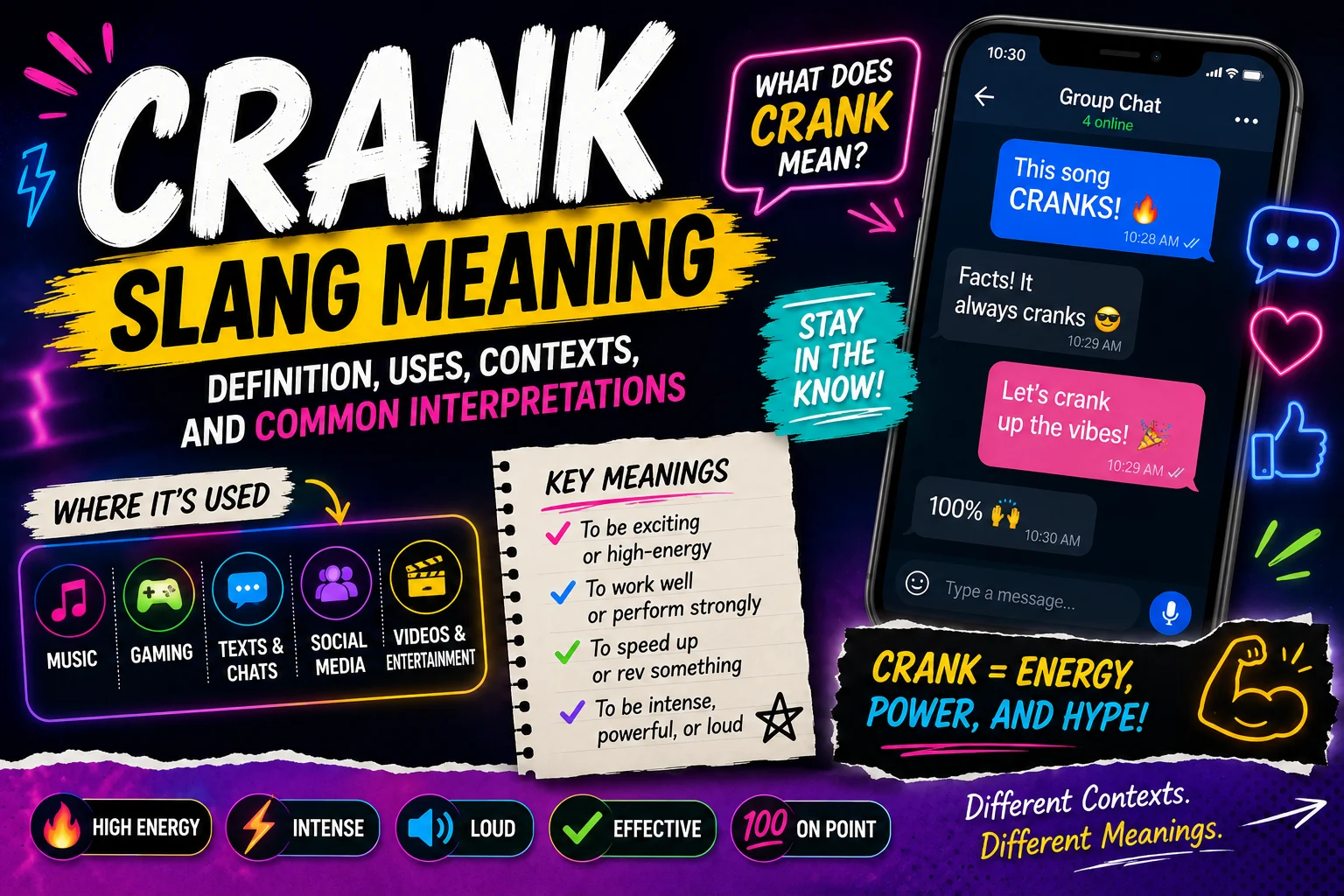
The slang meaning of “crank” usually refers to a person who behaves in an unusual, annoying, extreme, or eccentric way. Depending on the tone, it can be used as a mild insult, a humorous description, or even a nickname for someone who is obsessed with a particular idea or activity.
In casual speech, calling someone a “crank” may suggest that the person is difficult, strange, or overly opinionated. For example, someone who constantly complains about small issues or promotes unusual theories might be described as a crank. The word often carries a negative feeling, but it is not always meant to be offensive.
Another slang use of “crank” is related to energy or intense activity. The phrase “crank it up” means to increase something, such as volume, speed, or effort. In this sense, “crank” suggests action, power, or intensity rather than describing a person.
The meaning also depends on regional and cultural differences. In some places, “crank” may sound old-fashioned, while in others it remains a common informal expression. Online, users often use it playfully when talking about someone who is passionate, dramatic, or unpredictable.
The key idea is that “crank” in slang is not a single fixed definition. It can mean a strange person, a complainer, an obsessive individual, or something related to increasing energy or effort. The surrounding words and the speaker’s intention determine the exact meaning.
Background and History of the Word Crank
The word “crank” has a long history and originally did not begin as slang. It came from older English usage connected with movement and mechanical devices. A crank was a part of a machine that converted circular motion into another type of movement. Over time, the word developed several meanings beyond engineering.
The connection between machines and human behavior helped shape some modern meanings. A machine with a faulty crank might move unevenly or behave unpredictably, and eventually “crank” became associated with people who seemed unusual or difficult. By the 19th and early 20th centuries, “crank” was often used to describe someone with strange opinions or extreme beliefs.
The word also gained popularity in American and British informal speech. A person who was considered eccentric, stubborn, or constantly dissatisfied could be called a crank. Writers and journalists sometimes used the term to describe individuals who promoted unusual ideas without strong evidence.
In another historical context, “crank” became associated with enthusiasm and obsession. Someone deeply interested in a specific subject, hobby, or activity could be called a crank. For example, a person who spends all their time studying a particular topic might be described as a “history crank” or “technology crank.”
Today, the word continues to evolve. Internet culture has expanded its meanings, allowing “crank” to appear in jokes, memes, gaming communities, and social conversations. While the traditional meaning often suggests someone strange or difficult, modern usage can be playful or affectionate depending on the relationship between speakers.
Usage in Different Contexts (Chat, Social Media, Professional Fields)
The meaning of “crank” changes significantly depending on the environment where it appears. In informal communication, especially online, people often use slang meanings rather than traditional dictionary definitions.
In everyday chat, calling someone a “crank” may suggest that they are acting irritated, unusual, or overly dramatic. Friends might use it jokingly to describe someone who is being difficult for a moment. However, if used by strangers or during an argument, it may sound insulting.
On social media platforms, “crank” can appear in comments, captions, and discussions. Users may describe a person as a crank when criticizing extreme opinions or unusual behavior. It may also appear in humorous content where someone is portrayed as overly passionate about a topic.
In professional fields, the word usually has a different meaning. Engineers may use “crank” to describe a mechanical component. Writers or researchers may use “crank” historically when discussing unusual thinkers or controversial figures. In these cases, it is not casual slang but a specific descriptive term.
The tone matters greatly. For example:
- “He is a crank who complains about everything” suggests annoyance.
- “My grandfather is a gardening crank” may simply mean he is extremely passionate about gardening.
- “Turn the crank” refers to a mechanical action.
Because the word has multiple meanings, readers should consider the speaker, platform, and surrounding conversation before interpreting it.
Meaning in Chat, WhatsApp, Instagram, and TikTok
On messaging apps and social media platforms, the slang meaning of “crank” is often informal and context-dependent. People may use it in conversations to describe personality, behavior, or mood.
In WhatsApp chats, someone might call another person a “crank” if they are being grumpy, stubborn, or unusually demanding. Among friends, it can be teasing rather than a serious insult.
On Instagram and TikTok, “crank” may appear in comments or videos describing someone who acts strangely, has an intense personality, or becomes obsessed with a particular trend. Social media language changes quickly, so the word may sometimes be used humorously without its traditional negative meaning.
The phrase “crank up” is also common online. Creators may write “crank up the volume” or “crank it up” to encourage people to increase energy, excitement, or intensity. This usage is usually positive.
In dating apps, calling someone a “crank” can be risky because the meaning may not be clear. It could suggest that someone is difficult, negative, or unusual. However, between people who share humor and understand each other’s style, it might be playful.
When interpreting “crank” online, users should look at:
- The relationship between the people involved
- The tone of the message
- Whether emojis or jokes are included
- The surrounding conversation
A single word can shift from friendly teasing to criticism depending on the context.
Meaning in Physics, Medical, and Aircraft Terminology
Outside slang, “crank” has important technical meanings in science, medicine, and aviation.
In physics and engineering, a crank is a mechanical device that transforms rotational motion into linear motion or vice versa. A common example is the crankshaft in an engine. The crank mechanism plays an important role in converting energy and controlling movement in machines.
In medical discussions, “crank” is not usually a standard medical term, but related words may appear in descriptions of movement, mechanical devices, or historical medical equipment. Medical professionals generally use more precise terminology rather than slang expressions.
In aircraft terminology, crank-related terms are usually connected to mechanical systems. Aircraft engines contain components that rely on controlled movement, and crankshafts are essential parts of many piston engines. Engineers analyze crank systems to ensure reliability, balance, and performance.
These technical meanings are completely different from the slang meaning. In engineering, “crank” refers to a physical component. In social conversations, it may describe a person’s behavior or personality.
Understanding the difference prevents confusion. Someone reading a technical manual about aircraft engines will not encounter the same meaning as someone reading a social media comment calling a person a crank.
Common Misconceptions About Crank
One common misconception is that “crank” always means an insult. While the word can be negative, it is not always offensive. The meaning depends on tone, intention, and context.
Another misunderstanding is confusing “crank” with “crazy.” Although the words may overlap in some situations, they are not identical. A crank may simply be someone with unusual opinions, strong interests, or a habit of complaining. It does not automatically describe someone’s mental health or intelligence.
Some people also confuse “crank” with drug-related slang meanings. In certain regions and contexts, similar words may have separate meanings, but those meanings should not be assumed without context.
Another misconception is that technical uses of “crank” are related to slang. They are separate meanings that developed from different uses of the word. A mechanical crank in an engine has no connection to describing a person.
Because “crank” has existed for centuries, its meanings have expanded. Modern communication requires paying attention to context instead of relying on one definition.
Similar Terms and Alternatives
Several words can be related to “crank,” but their meanings are not exactly the same.
Words similar to the slang meaning include:
- Oddball: A person who behaves differently or unusually.
- Eccentric: Someone with unique habits or ideas, often in a more positive way.
- Grump: A person who is frequently annoyed or unhappy.
- Complainer: Someone who often expresses dissatisfaction.
- Weirdo: An informal term for someone considered strange.
- Fanatic: Someone extremely passionate about something.
For the mechanical meaning, similar terms include:
- Lever
- Handle
- Gear mechanism
- Rotating arm
- Drive component
The best alternative depends on the intended meaning. Calling someone an “eccentric” may sound more respectful than calling them a “crank.” Calling a machine part a “handle” may be inaccurate if the part specifically functions as a crank.
How to Respond When Someone Calls You a Crank
The best response depends on the situation and relationship.
If a friend uses “crank” jokingly, a humorous reply may work:
- “Maybe, but I know what I’m talking about.”
- “Only on certain topics!”
- “I’ll accept that title.”
If someone uses it as an insult, a calm response can help clarify their intention:
- “What makes you say that?”
- “Do you mean that seriously or jokingly?”
- “Can you explain what you mean?”
In online conversations, it is often better not to immediately assume hostility. Internet discussions frequently use exaggerated language for humor.
If the word appears in a professional or technical setting, respond according to the technical meaning rather than the slang interpretation.
Differences From Similar Words
Although “crank” overlaps with words like “weirdo,” “eccentric,” and “grump,” there are important differences.
An eccentric person is usually unusual but may be admired for creativity or originality. A crank often suggests that someone’s unusual ideas are annoying, unrealistic, or overly extreme.
A grump mainly refers to someone’s mood or tendency to complain. A crank may refer to opinions, behavior, or personality.
A fanatic describes extreme dedication or enthusiasm, while a crank often implies unusual or questionable beliefs.
The word “strange” is more neutral, while “crank” usually carries a stronger judgment. However, among friends, it can become a playful nickname rather than criticism.
Relevance in Online Conversations and Dating Apps
The use of “crank” in online conversations shows how language changes in digital spaces. Social media, messaging apps, and dating platforms often create situations where short words carry different meanings.
On dating apps, understanding slang is especially important because tone is harder to recognize through text. Someone describing themselves as a “crank” might mean they are quirky and opinionated, while someone calling another person a crank may be criticizing their personality.
Online communities also use the term when discussing people with extreme views or unusual behavior. In debates, “crank” may be used to dismiss someone’s ideas rather than address them directly.
Because digital communication lacks facial expressions and voice tone, users should consider context before reacting. Asking for clarification is often the easiest way to understand the intended meaning.
Conclusion
The slang meaning of “crank” depends heavily on context. It can describe someone who is unusual, difficult, overly opinionated, or extremely passionate about a subject. In friendly conversations, it may be playful, while in arguments it can become a criticism.
Beyond slang, “crank” has important meanings in engineering, physics, and aircraft terminology, where it refers to mechanical components and movement systems. These meanings show how one word can develop different uses over time.
When you see “crank” in chats, social media, dating apps, or professional discussions, look at the surrounding information before deciding what it means. Understanding context is the key to interpreting modern language accurately.
Whether used as slang or a technical term, “crank” remains a word with a surprisingly wide range of meanings.
Woke Slang Meaning: What It Means in Chat, Social Media, Politics, and Everyday Conversations

I am a professional content writer with a passion for English grammar, slang, vocabulary, and everyday language. I specialize in creating clear, engaging, and easy-to-understand articles about grammar rules, slang meanings, phrases, expressions, and modern English usage. My goal is to help readers understand language better, communicate naturally, and use English with confidence.