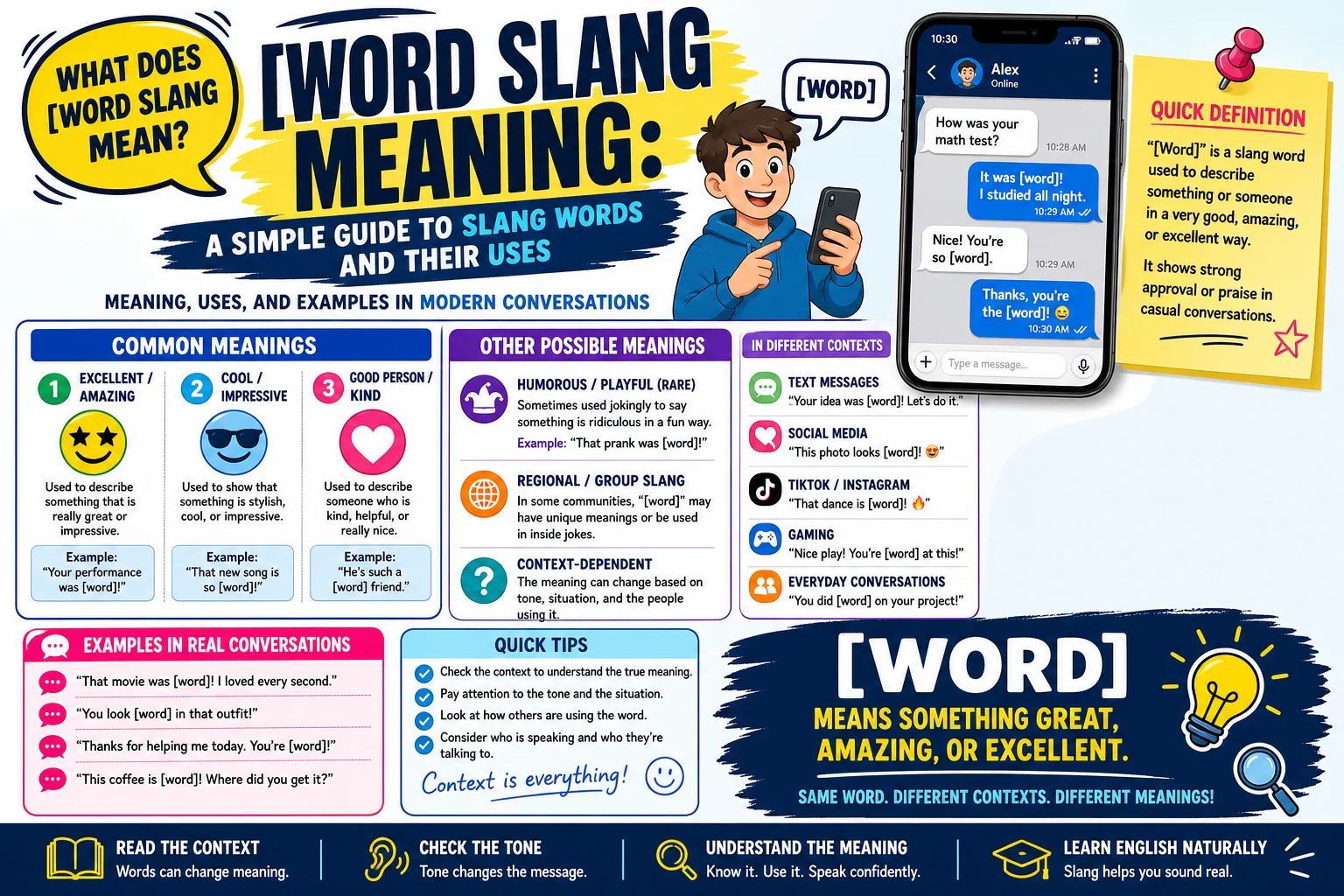
Have you ever received a text message and seen a word that made you stop and think, “What does that mean?” Slang can make everyday communication confusing, especially when a word has a different meaning from its normal dictionary definition.
The word slang meaning usually refers to the informal or special meaning a word has in casual speech, online conversations, social media, or a particular group. Slang changes quickly. A word that means one thing in a dictionary may have a completely different meaning on TikTok, Instagram, WhatsApp, or a dating app.
Understanding slang is useful because it helps you follow modern conversations and avoid misunderstandings. It can also help you understand the tone behind a message. A slang word may show humor, friendship, excitement, sarcasm, attraction, or even disrespect.
In this guide, we will explore how slang works, where it comes from, how context changes its meaning, and how to understand unfamiliar slang without jumping to the wrong conclusion.
Meaning & Definition
Slang is informal language used by people in casual conversation. It can include words, phrases, abbreviations, shortened expressions, or terms that are popular within a certain community.
A slang word may not be considered appropriate in formal writing. However, that does not mean it is meaningless or incorrect. Slang often has a clear meaning within the group that uses it.
For example, the word “cool” traditionally relates to temperature. In casual English, however, “cool” can mean something is good, impressive, fashionable, or acceptable.
Likewise, “lit” can literally relate to something being illuminated, while modern slang can use it to describe something exciting or enjoyable.
This shows why context matters.
Slang vs. Dictionary Meaning
A word can have several meanings:
- Literal meaning: The normal dictionary definition.
- Slang meaning: An informal meaning used by a particular group.
- Technical meaning: A specialized meaning used in a field.
- Figurative meaning: A meaning that is not literal.
The same word can move between these categories depending on who says it and where it appears.
Slang also changes over time. Some slang terms become common English words, while others disappear after a few years.
Background: Where Does Slang Come From?
Slang has existed for centuries. People have always created informal words to express ideas quickly or to build a sense of belonging.
Slang can develop among young people, musicians, workers, sports fans, online communities, and many other groups. Movies, music, television, gaming, and social media can then spread these expressions to a much wider audience.
The internet has made this process much faster.
A phrase can become popular on one social platform and appear around the world within days. Users may shorten words, create abbreviations, change spellings, or give existing words new meanings.
For example, internet culture has popularized expressions such as “LOL,” “DM,” “AFK,” “GOAT,” and many other terms.
Slang also reflects culture. Different countries and communities may use different slang even when they speak the same language.
This is why understanding slang requires more than simply checking a dictionary. You often need to consider time, place, community, and context.
Usage in Different Contexts
The meaning of slang can change greatly depending on the situation.
Casual Chat
Friends often use slang to make conversations shorter and more relaxed. A phrase may sound natural between friends but strange in a formal email.
Social Media
Social platforms create and spread new expressions quickly. Comments, captions, memes, and viral videos can give ordinary words new meanings.
Professional Fields
Some informal terms are also used within workplaces or industries. Workers may use specialized expressions that sound like slang to outsiders.
However, professional communication usually requires more care. A word that is acceptable in a casual conversation may not be suitable in a business report or official document.
Online Communities
Gaming, sports, technology, music, and other online communities often develop their own vocabulary. A person unfamiliar with the community may struggle to understand a conversation even when every word looks familiar.
The key lesson is simple: never judge a slang word without looking at the surrounding sentence.
Meaning in Chat, WhatsApp, Instagram, and TikTok
Slang is especially common in messaging and social media.
On WhatsApp, people often use shortened expressions because quick communication is the goal. Messages may include abbreviations, emojis, and casual spellings.
On Instagram, slang may appear in captions, comments, direct messages, and memes. The meaning can sometimes depend on a trend or a specific online community.
On TikTok, slang can spread extremely quickly. A word may become popular because of a viral video, song, joke, or meme. Its meaning may also change as more people begin using it.
For example, an expression may begin as an inside joke and later become common online language.
Why Context Matters
Consider the word “sick.”
In its traditional meaning, it can describe someone who is unwell.
In slang, however, “That was sick!” can mean something was excellent, impressive, or exciting.
So if someone writes “That outfit is sick 🔥,” they probably are not saying the outfit is unhealthy. They are using informal slang to express approval.
This is why the best way to understand slang is to examine the sentence, tone, emojis, platform, and relationship between the people communicating.
Meaning in Physics, Medical, and Aircraft Terminology
Not every unusual word is slang. This is an important distinction.
A word may have a completely different meaning in a technical field.
Physics
Physics uses specialized terminology that may sound unfamiliar in everyday conversation. Words such as force, work, power, momentum, and energy have precise scientific meanings.
For example, “work” has a specific meaning in physics that differs from its everyday use.
Medical Terminology
Medicine also uses words with highly specific meanings. A term that sounds casual may describe a precise condition, symptom, procedure, or body function.
Medical terminology should therefore not automatically be treated as slang.
Aircraft and Aviation
Aviation has its own technical vocabulary and abbreviations. Pilots, air traffic controllers, engineers, and aviation workers use specialized terms to communicate clearly and safely.
Some aviation expressions may be informal within the industry, but many are technical terms rather than slang.
The important difference is that technical terminology is normally designed for precision, while slang is usually informal and shaped by social use.
Common Misconceptions About Slang
One common misconception is that all slang has only one meaning. In reality, a slang word can mean different things in different communities.
Another misconception is that slang is always rude or offensive. Some slang is completely harmless and simply makes speech more casual.
People also sometimes assume that a popular online term has the same meaning everywhere. This can lead to confusion because slang varies by country, age group, platform, and culture.
A final misconception is that slang is always new. Some slang expressions have been used for decades or even longer.
When you see an unfamiliar word, it is better to ask, “What does this mean in this context?” rather than assuming the word has a single fixed definition.
Similar Terms & Alternatives
Several terms are related to slang but are not exactly the same.
- Colloquialism: An informal expression commonly used in everyday speech.
- Jargon: Specialized language used by a particular profession or group.
- Idiom: A phrase whose meaning is different from the literal meaning of its individual words.
- Abbreviation: A shortened form of a word or phrase.
- Acronym: A term formed from the first letters of several words.
- Vernacular: The language naturally used by a particular group or region.
- Informal language: Relaxed language used outside formal situations.
Understanding these differences can make it easier to identify what you are actually seeing.
How to Respond to an Unfamiliar Slang Word
If someone uses slang that you do not understand, there is no need to guess.
You can simply ask:
- “What does that mean?”
- “What do you mean by that?”
- “I haven’t heard that expression before.”
- “Is that slang?”
- “Can you explain what you mean?”
In a friendly conversation, asking can even make the discussion more interesting.
If you do not want to ask directly, look at the surrounding conversation. The words before and after the slang term may provide useful clues.
You can also consider the platform. A word used on TikTok may have a different meaning from the same word used in a workplace conversation.
Differences From Similar Words
Slang should not be confused with a synonym.
A synonym is a word with a similar meaning to another word. Slang is about how a word or expression is used informally.
For example, “friend” and “buddy” have similar meanings, but “buddy” can sound more casual.
Likewise, “excellent” and “awesome” may communicate similar ideas, but “awesome” is more informal in many situations.
The difference is often about tone, audience, and setting.
Formal language is generally preferred in academic work, professional documents, and official communication. Slang is more common among friends, online communities, and casual conversations.
Relevance in Online Conversations & Dating Apps
Slang has become especially important in online dating and social communication.
A short message can sometimes be difficult to interpret because text does not always show facial expressions or voice tone. Slang, emojis, abbreviations, and punctuation can add emotional meaning.
For example, a slang expression might suggest that someone is joking, flirting, showing excitement, or trying to sound relaxed.
However, slang should not be treated as a guaranteed sign of romantic interest. Context matters more than one word.
If someone uses an unfamiliar expression on a dating app, look at the full message and the conversation before deciding what they mean.
When the meaning remains unclear, the safest approach is to ask politely.
Conclusion
Understanding word slang meaning is really about understanding language in context. A slang word may have a different meaning from its dictionary definition, and its meaning can change across social media, messaging apps, communities, countries, and generations.
Slang is not the same as technical language, jargon, or an ordinary synonym. It is informal language shaped by the people who use it.
When you encounter an unfamiliar expression, look at the surrounding words, platform, tone, and situation. If you are still unsure, simply ask what the person means.
Language keeps changing, especially online. Learning how slang works can help you communicate more clearly, understand social conversations, and avoid unnecessary misunderstandings.
The best way to understand any slang word is to understand the context in which it is used.
Goat Slang Meaning: Complete Guide to Its Definition, Origins, Uses, and Online Conversations

I am a professional content writer with a passion for English grammar, slang, vocabulary, and everyday language. I specialize in creating clear, engaging, and easy-to-understand articles about grammar rules, slang meanings, phrases, expressions, and modern English usage. My goal is to help readers understand language better, communicate naturally, and use English with confidence.