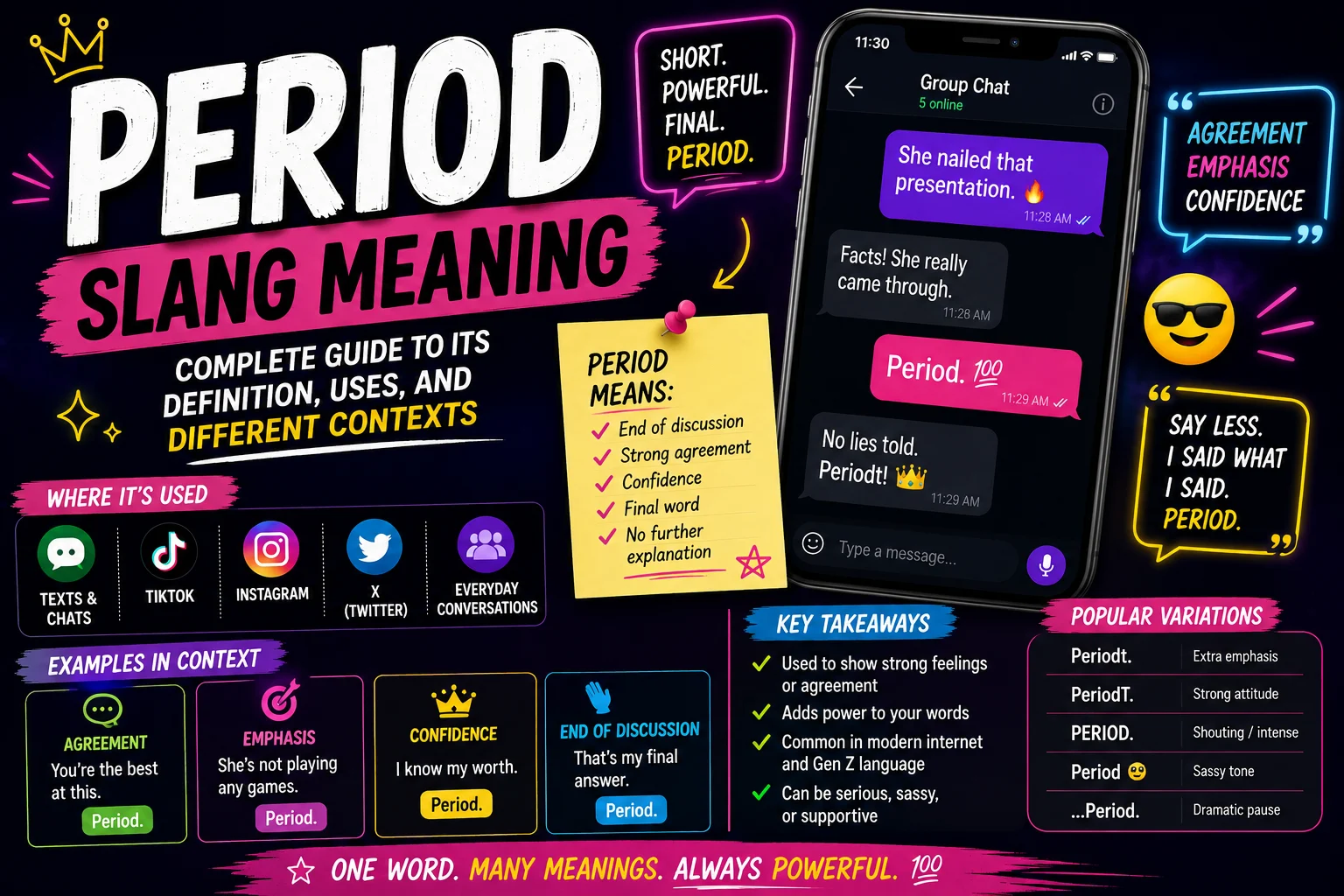
The phrase period slang meaning has become one of the most searched language-related topics as internet culture continues to shape the way people communicate. If you’ve seen someone end a sentence with “period” on TikTok, Instagram, WhatsApp, or X (formerly Twitter), you may have wondered whether they were referring to punctuation, menstruation, or something entirely different. In modern slang, “period” has developed a unique meaning that emphasizes confidence, certainty, and finality.
People search for this expression because it appears frequently in social media captions, text messages, memes, and online conversations. Understanding its meaning helps avoid confusion and allows you to interpret conversations correctly. While the slang version is popular among younger generations, the word also has established meanings in grammar, medicine, science, and aviation. This guide explains each meaning clearly, explores its origins, shows how it is used across different situations, and highlights the differences between its slang and traditional definitions.
Meaning & Definition
In modern slang, “period” is used to express that a statement is final, unquestionable, or not open for debate. It works as a verbal full stop, signaling that nothing more needs to be said.
For example:
- “She’s the best singer, period.”
- “Respect yourself. Period.”
- “That’s the truth, period.”
Here, the speaker is emphasizing confidence and certainty. Instead of inviting discussion, the word reinforces the opinion as complete and definitive.
Traditionally, period has several dictionary meanings:
- A punctuation mark (.)
- A length of time
- A stage or era in history
- Menstruation
- A recurring cycle in science or mathematics
The slang meaning differs because it focuses entirely on emphasis rather than literal definition.
Linguistically, the slang functions as an intensifier. Similar to expressions like “end of story” or “that’s final,” it strengthens the emotional impact of a statement.
Many younger speakers also say “periodt,” adding an extra “t” for dramatic emphasis. Although the spelling changes, the intended meaning remains the same.
Because of its flexibility, “period” can express confidence, support, excitement, agreement, or even playful exaggeration depending on tone and context.
Background
The slang use of “period” became widely recognized through African American Vernacular English (AAVE), where it has long been used to emphasize finality in conversation. Over time, the expression spread through online communities, popular culture, music, and entertainment.
Social media platforms accelerated its popularity. Short-form videos, memes, reaction clips, and celebrity interviews introduced the phrase to millions of users worldwide. Influencers frequently ended strong opinions with “period” to add confidence and personality.
Around the late 2010s and early 2020s, TikTok played a significant role in making the phrase mainstream. Users began including it in captions, comments, and hashtags, while creators often used dramatic voiceovers ending with “period.”
The variation “periodt” gained attention through internet personalities and drag culture, where expressive speech and theatrical delivery helped popularize the pronunciation.
Today, the slang is widely understood across many English-speaking communities, although its popularity varies by age group. Younger audiences tend to use it naturally, while older speakers may associate the word only with punctuation or menstruation.
As internet language evolves, “period” demonstrates how ordinary words can develop entirely new meanings through culture, media, and everyday online communication.
Usage in Different Contexts (Chat, Social Media, Professional Fields)
The meaning of “period” changes depending on where it is used.
In casual conversations
Friends often use it to reinforce opinions.
Examples:
- “You deserve better, period.”
- “That movie was amazing, period.”
On social media
Influencers frequently use it in captions:
- “Confidence looks good on everyone. Period.”
- “Self-care comes first. Period.”
It creates a strong, memorable ending that encourages engagement.
In text messaging
The word often replaces longer phrases such as:
- “That’s final.”
- “No further discussion.”
- “End of story.”
In professional settings
The slang meaning is generally avoided in formal communication because it can sound overly casual or dismissive.
Instead, professionals prefer expressions like:
- “This is our final decision.”
- “The matter is closed.”
- “This concludes the discussion.”
However, the standard dictionary meanings of “period” remain common in professional writing, especially in education, healthcare, science, and publishing.
Understanding context is essential because the intended meaning depends entirely on the conversation.
Meaning in Chat, WhatsApp, Instagram, TikTok
The slang appears most frequently on digital platforms.
Friends use it for emphasis.
Example:
“You’re coming with us, period.”
It signals confidence rather than anger.
Captions often end with:
- “Living my best life. Period.”
- “No negativity allowed. Period.”
This creates a bold and memorable statement.
TikTok
TikTok popularized dramatic uses of the expression.
Creators may say:
- “She ate. Period.”
- “That’s iconic. Period.”
Here, it reinforces admiration or approval.
Gaming chats
Players sometimes write:
- “We won, period.”
This expresses certainty and celebration.
Online comments
Users often reply simply:
- “Period.”
- “Periodt.”
In these cases, the word means complete agreement with another person’s statement.
Meaning in Physics, Medical, and Aircraft Terminology
Outside slang, “period” has several technical meanings.
Physics
In physics, a period is the time required for one complete cycle of a repeating motion.
Examples include:
- Pendulums
- Sound waves
- Light waves
- Rotating objects
It is commonly represented by the symbol T.
Medical
In medicine, “period” most commonly refers to menstruation—the monthly shedding of the uterine lining.
Doctors may also use “period” to describe a span of recovery, observation, or treatment, such as a recovery period after surgery.
Aircraft and aviation
In aviation, “period” usually refers to a specific duration or operational timeframe rather than a flight component.
Examples include:
- Maintenance period
- Inspection period
- Training period
- Flight duty period
Unlike social media slang, these technical meanings are precise and context-specific.
Common Misconceptions
Several misunderstandings surround the slang use of “period.”
It only means menstruation
False. While that remains a common dictionary definition, slang uses are completely different.
It is rude
Not necessarily.
It can sound confident, humorous, or supportive depending on tone. However, using it in serious workplace discussions may seem abrupt.
Everyone uses it
Although widely recognized, it is much more common among younger internet users than older generations.
“Periodt” is a different word
No.
It simply adds extra emphasis through pronunciation and spelling.
It always ends arguments
Not always.
Some people use it playfully rather than literally ending the conversation.
Similar Terms & Alternatives
Several expressions communicate similar meanings.
Common alternatives include:
- End of story
- That’s final
- Absolutely
- No question
- No doubt
- Exactly
- For sure
- Without exception
- Case closed
- Full stop (especially in British English)
Each carries slightly different levels of formality.
For example:
- “Case closed” sounds more decisive.
- “Exactly” signals agreement.
- “Full stop” closely matches the slang meaning of “period.”
Choosing the right alternative depends on your audience and situation.
How to Respond to It
When someone ends a sentence with “period,” your response depends on whether you agree or disagree.
If you agree, you can reply:
- “Exactly!”
- “Facts.”
- “Couldn’t agree more.”
- “Absolutely.”
- “True.”
If you’re unsure, ask politely:
- “What do you mean by that?”
- “Can you explain?”
If you disagree, remain respectful:
- “I see your point, but I have a different opinion.”
- “That’s one perspective.”
Understanding the speaker’s tone is important because many people use “period” humorously rather than seriously.
Differences from Similar Words
Although similar expressions emphasize certainty, they are not identical.
| Expression | Primary Meaning |
|---|---|
| Period | Final, no debate |
| Full stop | British equivalent emphasizing finality |
| Exactly | Agreement with someone |
| Definitely | Strong certainty |
| End of story | Discussion is considered finished |
| Case closed | Matter is settled, often humorously |
The slang version of “period” stands out because it is brief, memorable, and widely recognized in online culture.
Relevance in Online Conversations & Dating Apps
Modern internet communication values short, expressive language. “Period” fits perfectly because it adds personality without requiring long explanations.
On dating apps, users may write:
- “Honesty only. Period.”
- “Respect matters. Period.”
These statements communicate firm expectations.
In online communities, the word often signals confidence, empowerment, or agreement.
Content creators also use it because it encourages engagement. Followers frequently respond with comments like:
- “Period!”
- “Periodt!”
- “Facts.”
Despite its popularity, moderation is important. Repeating the expression too often can make conversations sound repetitive or forced.
For professional networking platforms, neutral language is usually a better choice.
Conclusion
Understanding the period slang meaning helps you navigate modern digital communication with confidence. While the word traditionally refers to punctuation, time, menstruation, or scientific cycles, its slang usage has evolved into a powerful expression of certainty and emphasis. Popularized through social media, music, and internet culture, it now appears regularly in chats, captions, comments, and videos across platforms like WhatsApp, Instagram, and TikTok.
The key to interpreting the word correctly is context. In casual online conversations, “period” often means “that’s final” or “there is nothing more to add.” In professional, medical, scientific, or aviation settings, however, it retains its original technical meanings. By recognizing these differences, you can communicate more effectively, understand online trends, and respond appropriately in both informal and formal situations.
Lit Slang Meaning: What Does “Lit” Mean in Modern Conversations and Online Culture?

I am a professional content writer with a passion for English grammar, slang, vocabulary, and everyday language. I specialize in creating clear, engaging, and easy-to-understand articles about grammar rules, slang meanings, phrases, expressions, and modern English usage. My goal is to help readers understand language better, communicate naturally, and use English with confidence.