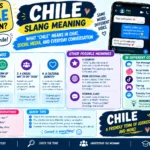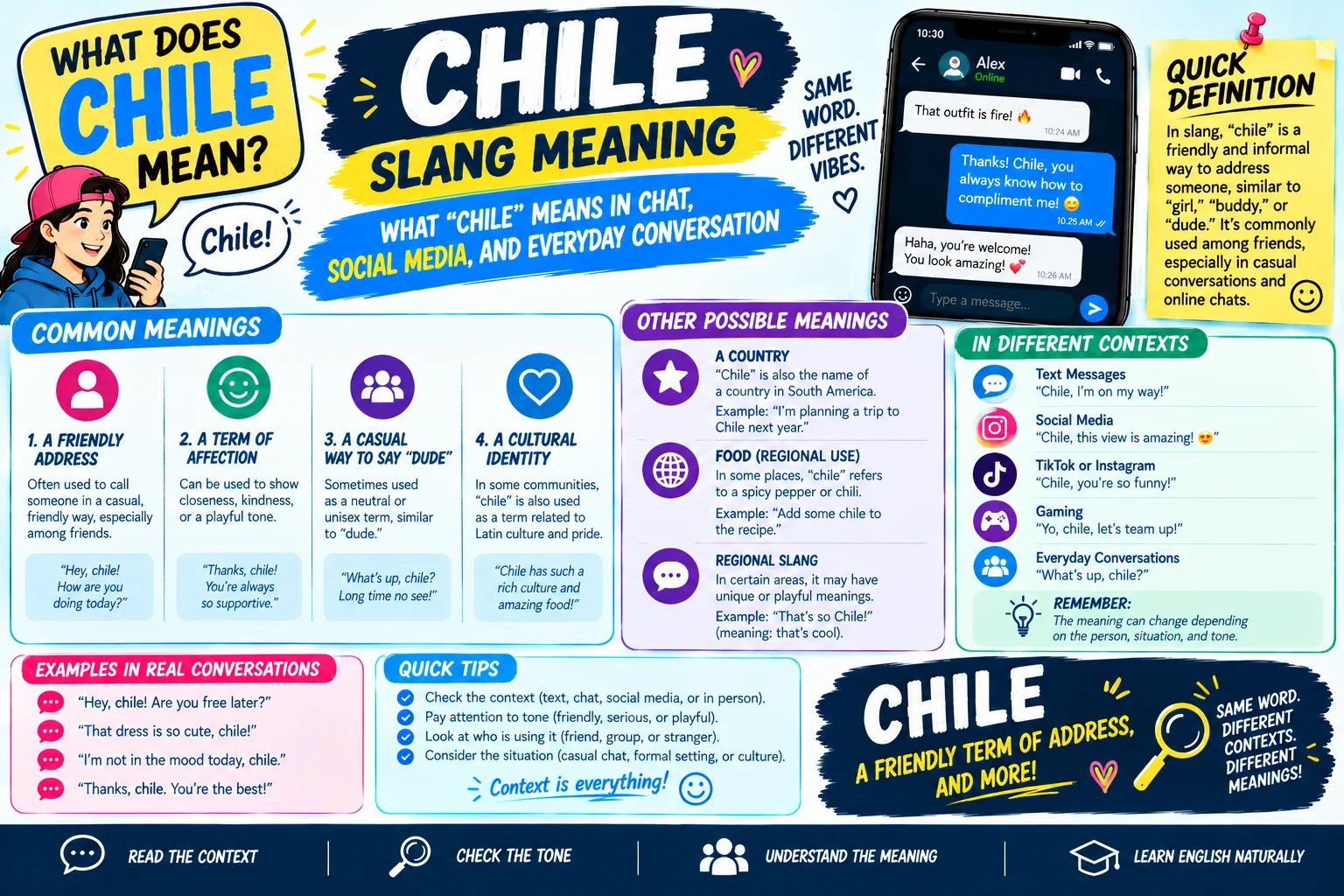
If you have seen someone write “Chile…” or “Chileeee!” online, you may have wondered whether they mean the South American country, chili peppers, or something completely different. In modern internet slang, “chile” is generally a playful, expressive spelling associated with “child” and is often used as a reaction to something surprising, dramatic, funny, frustrating, or unbelievable.
People search for the chile slang meaning because the word can look confusing when removed from its context. A message such as “Chile, I cannot believe he did that” is not normally talking about geography or food. Instead, “chile” adds emotion and personality to the sentence.
The expression has roots in African American Vernacular English (AAVE) and Black American speech, particularly Southern usage, before becoming increasingly visible in internet culture and social media. Understanding its background and tone makes it much easier to interpret comments, texts, memes, and conversations without taking the word literally.
Meaning & Definition
In slang, “chile” is an informal expression used to convey a strong reaction. It can suggest disbelief, exasperation, amusement, surprise, embarrassment, or simply a dramatic pause before commenting on a situation.
Although it is commonly described online as a stylized pronunciation or spelling of “child,” its modern slang function is more important than its literal meaning. A person writing “chile…” is often not addressing an actual child. Instead, they are reacting to something that has caught their attention.
For example:
- “Chile, what just happened?”
- “Chileeee, I cannot deal with this.”
- “Whew, chile!”
- “Chile, please.”
- “Oh chile, that is messy.”
Depending on context, these could communicate feelings similar to “wow,” “oh my,” “seriously?,” “I can’t believe this,” or “here we go again.”
The spelling can also communicate tone. Writing “chile” may sound relatively mild, while “chileeee” or “chiiiiile” can make the reaction seem more dramatic or humorous. Online spelling often functions almost like vocal emphasis.
It is therefore better to think of “chile” as a tone-rich reaction expression, rather than a word with one fixed English translation. The surrounding sentence, punctuation, emojis, and conversation determine what the speaker intends.
One important distinction is that this slang usage is separate from Chile, the country, and from chile/chili as a food-related word. Context is what tells you which meaning is intended.
Background
The modern slang use of “chile” has cultural roots that predate TikTok and other contemporary platforms. The expression is associated with African American Vernacular English (AAVE) and has been used in Black American communities, particularly in Southern speech, where “chile” can refer to a child or be incorporated into expressive phrases.
Over time, expressions such as “whew, chile” became recognizable beyond their original speech communities. The phrase can introduce a reaction to something exhausting, surprising, ridiculous, or dramatic. Its appeal comes partly from the rhythm and emotion contained in the expression.
Internet culture then helped spread the term to a much wider audience. Social platforms favor short expressions that communicate an entire emotional response quickly, making “chile” particularly useful in comments, memes, reaction posts, and storytelling.
The expression has also appeared in popular culture and online celebrity conversations. Its visibility increased as Black internet culture and AAVE-influenced expressions became increasingly prominent across social media. Importantly, that wider popularity does not erase its cultural origins.
This background matters because slang is not simply a collection of random internet words. Expressions often emerge from particular communities and linguistic traditions before being adopted more broadly. “Chile” is a good example of how speech patterns can move from spoken language into written digital communication.
Today, someone may encounter the expression even if they have never heard it spoken aloud. That can make its spelling seem strange at first. The spelling deliberately represents a pronunciation and expressive style rather than following standard English spelling conventions.
Because slang changes quickly, the exact tone can vary between communities. Nevertheless, the central idea remains consistent: “chile” is an expressive, informal way to react to a situation or address someone in a conversational style.
Usage in Different Contexts: Chat, Social Media, and Professional Fields
The meaning of “chile” changes less by platform than by social setting and tone. It is overwhelmingly associated with informal communication.
Casual Chat
In conversations between friends, “chile” can introduce gossip, surprise, frustration, or amusement.
“Chile, you will not believe what happened.”
Here, it creates suspense and signals that the speaker has a strong reaction to the story.
Social Media
On Instagram, TikTok, X, and similar platforms, the word frequently appears in comments reacting to dramatic or funny content. Someone might write:
“Chileeee 😭”
The message may communicate an entire reaction without explaining anything further.
Professional Communication
“Chile” generally does not belong in formal workplace communication. Using it in a business email, academic paper, official report, or professional presentation may confuse readers or make the message sound overly casual.
For example, instead of writing:
“Chile, that deadline is crazy.”
a professional message would normally say:
“That deadline is unusually tight.”
This does not mean slang is inherently inappropriate. It simply means that audience and setting matter.
Storytelling and Entertainment
The term works especially well when someone is recounting something dramatic:
“Chile, I walked into the meeting and everyone was silent.”
In this context, it functions almost like a theatrical pause before the story continues.
The safest rule is simple: use “chile” when the conversation is casual and the audience understands internet or AAVE-influenced slang; avoid it when clarity and formality are priorities.
Meaning in Chat, WhatsApp, Instagram, and TikTok
In messaging and social media, “chile” is usually an emotional reaction rather than a literal reference.
On WhatsApp, friends may use it to respond to gossip or unexpected news:
“He called me again after saying he was done.”
“Chile… not again 😭”
On Instagram, it may appear in comments underneath celebrity posts, relationship drama, memes, or surprising announcements:
“Chile, I knew this was coming.”
On TikTok, the expression is particularly useful because TikTok culture revolves heavily around reactions, storytelling, humor, and commentary. A commenter might write:
“Chileeee, the plot twist!”
The word can also be combined with other expressions. “Chile please” may communicate disbelief or dismissal, while “whew, chile” often signals that something has been exhausting, dramatic, or overwhelming.
Spelling variations are common. “Chile,” “chileee,” and “chiiiiile” can all communicate essentially the same idea, with additional letters usually adding dramatic emphasis.
Emojis can further change the tone. For example:
- “Chile 😭” — overwhelmed or amused
- “Chile 😂” — humorous disbelief
- “Chile… 👀” — suspicious or interested
- “CHILE!” — strong emphasis
The important point is that online slang is highly dependent on tone markers. Capitalization, repeated letters, punctuation, emojis, and surrounding words can make the same expression sound sympathetic, shocked, sarcastic, or amused.
Meaning in Physics, Medical, and Aircraft Terminology
One reason people sometimes become confused about “chile” is that they expect every search result to represent a technical definition. “Chile” does not have a standard, broadly recognized technical meaning in physics, medicine, or aircraft terminology as the slang expression described above.
Physics
In physics, “chile” is not a standard fundamental term, unit, law, or commonly recognized abbreviation. If it appears in physics material, it may be part of a proper name, place reference, dataset, acronym, or an unrelated word.
Medical Terminology
Likewise, “chile” is not a standard medical diagnosis or general clinical term. A medical document containing the word should therefore be interpreted according to its specific context rather than assuming it is internet slang.
Aircraft and Aviation
There is also no general aviation definition of “chile” corresponding to the slang expression. In an aircraft manual, flight document, or aviation database, the word could potentially occur as a geographical reference, identifier, proper name, or specialized abbreviation.
This distinction is important: the informal slang meaning should not be transferred into technical fields. If you encountered “CHILE” in a scientific, medical, or aviation document, check the surrounding terminology and capitalization before assigning it a slang definition.
Common Misconceptions
Several misunderstandings surround the word “chile.”
Misconception 1: It Always Means the Country
Not necessarily. Chile with a capital letter can refer to the South American country, but “chile” in a casual online reaction can have an entirely different meaning.
Misconception 2: It Is Simply a Spelling Mistake
It can resemble a misspelling of “child,” but in slang contexts the spelling is often intentional. It represents a pronunciation and expressive style rather than an accidental typo.
Misconception 3: It Literally Means “Child” Every Time
Not in modern online usage. A person saying “Chile, what happened?” usually is not identifying someone as a child. The expression acts more like an emotional reaction.
Misconception 4: It Originated on TikTok
TikTok helped spread the expression widely, but the underlying usage is older and has roots in Black American speech and AAVE.
Misconception 5: Everyone Uses It in Exactly the Same Way
Slang is flexible. One speaker may use “chile” affectionately, while another may use it for sarcasm, disbelief, or humor. Context matters.
Misconception 6: It Is Automatically Offensive
The expression itself is not inherently an insult. However, because it has cultural and linguistic roots, people should avoid treating AAVE-derived expressions as meaningless novelty words or using them in ways that mock the communities associated with them.
Similar Terms & Alternatives
Several informal expressions can perform a similar conversational function, although none is an exact replacement.
“Whew” can signal that something is exhausting or dramatic:
“Whew, that meeting was long.”
“Girl” is sometimes used conversationally as an expressive address, particularly in gossip or storytelling:
“Girl, you will never believe this.”
“Bruh” commonly communicates disbelief, frustration, amusement, or surprise:
“Bruh, what was that?”
“OMG” is a more direct expression of shock:
“OMG, did that really happen?”
“Wow” is more neutral and widely acceptable across different contexts.
“Seriously?” expresses disbelief but sounds less playful.
“Oh my” can provide a softer reaction.
The advantage of “chile” is its particular combination of humor, drama, rhythm, and cultural tone. That is why a simple “wow” may not feel like an equivalent replacement in a meme or casual conversation.
How to Respond to “Chile”
Your response should depend on what the person is communicating.
If someone says:
“Chile, you are not going to believe this.”
A natural response might be:
“What happened?”
If they say:
“Chileeee, that was wild!”
you could answer:
“I know! I was shocked too.”
If they use “chile” as part of a joke, matching their playful tone can work:
“Chile, I’m trying to survive over here 😂”
You can also simply continue the conversation without responding directly to the slang. There is no special response required.
If you are unsure whether the person means the slang expression or the country, look at the surrounding sentence. For example, “Chile has beautiful landscapes” clearly refers to the country, whereas “Chile, what are you doing?” is likely an expressive slang usage.
The safest approach is to focus on the sentence as a whole rather than translating “chile” word-for-word.
Differences From Similar Words
The key difference between “chile” and related words is function.
| Expression | Typical Function |
|---|---|
| Chile | Dramatic reaction, disbelief, humor, exasperation |
| Child | Literal reference to a young person |
| Girl | Informal address or expressive reaction |
| Bruh | Surprise, frustration, disbelief |
| Wow | General surprise or admiration |
| OMG | Strong surprise or shock |
| Seriously? | Questioning or disbelief |
| Chile (country) | Geographical proper noun |
The distinction between “chile” and “child” is particularly important. They may be related in pronunciation and linguistic development, but the slang expression often functions as an emotional interjection rather than a noun.
Capitalization can also provide clues. “Chile” in a sentence about South America is likely geographical. “chileeee” in a TikTok comment is almost certainly expressive slang.
Similarly, “chile” should not automatically be interpreted as “girl,” “bro,” or “wow.” Those alternatives overlap in some situations, but their cultural associations and tones differ.
Relevance in Online Conversations & Dating Apps
“Chile” can be especially useful in online dating conversations because dating apps frequently involve informal, humorous, and reaction-based communication.
Suppose someone says:
“He said he was not looking for anything serious, then asked me to meet his parents.”
A friend might respond:
“Chileeee, that man is confusing.”
Here, the expression signals disbelief and invites a humorous reaction.
In a dating-app conversation, however, tone matters. If someone writes:
“Chile, you’re trouble 😂”
they may be teasing or flirting rather than criticizing.
Likewise:
“Chile please 😭”
could indicate playful disbelief after a bold compliment or joke.
Because text lacks facial expressions and vocal tone, slang can sometimes be ambiguous. Emojis and punctuation help clarify intent, but they are not foolproof.
People should also remember that not every match will understand AAVE-influenced slang. If you are speaking with someone unfamiliar with the expression, a simpler phrase may communicate your meaning more clearly.
Ultimately, “chile” works online because it compresses a complicated emotional reaction into one memorable word. It can make messages feel conversational, dramatic, humorous, and spontaneous.
Conclusion
The chile slang meaning is best understood as an informal, expressive reaction rather than a literal reference to the country or to a young child. In modern online communication, “chile” can convey shock, disbelief, amusement, frustration, exhaustion, or dramatic emphasis. Its meaning depends heavily on context, tone, spelling, punctuation, and the relationship between the people communicating.
The expression has roots in African American speech and AAVE, particularly Black Southern usage, and later gained much broader visibility through internet culture and social media.
You may encounter it in WhatsApp messages, Instagram comments, TikTok videos, memes, and casual conversations, but it is generally unsuitable for formal professional writing. It also has no standard slang definition in physics, medicine, or aviation.
When you see “chile,” look at the surrounding message first. In most casual online contexts, it is simply a colorful way of saying, in effect, “Wow,” “Oh my,” “Seriously?” or “I cannot believe this.”
BBC Slang Meaning: Definition, Online Usage, Contexts, and What It Really Means

I am a professional content writer with a passion for English grammar, slang, vocabulary, and everyday language. I specialize in creating clear, engaging, and easy-to-understand articles about grammar rules, slang meanings, phrases, expressions, and modern English usage. My goal is to help readers understand language better, communicate naturally, and use English with confidence.