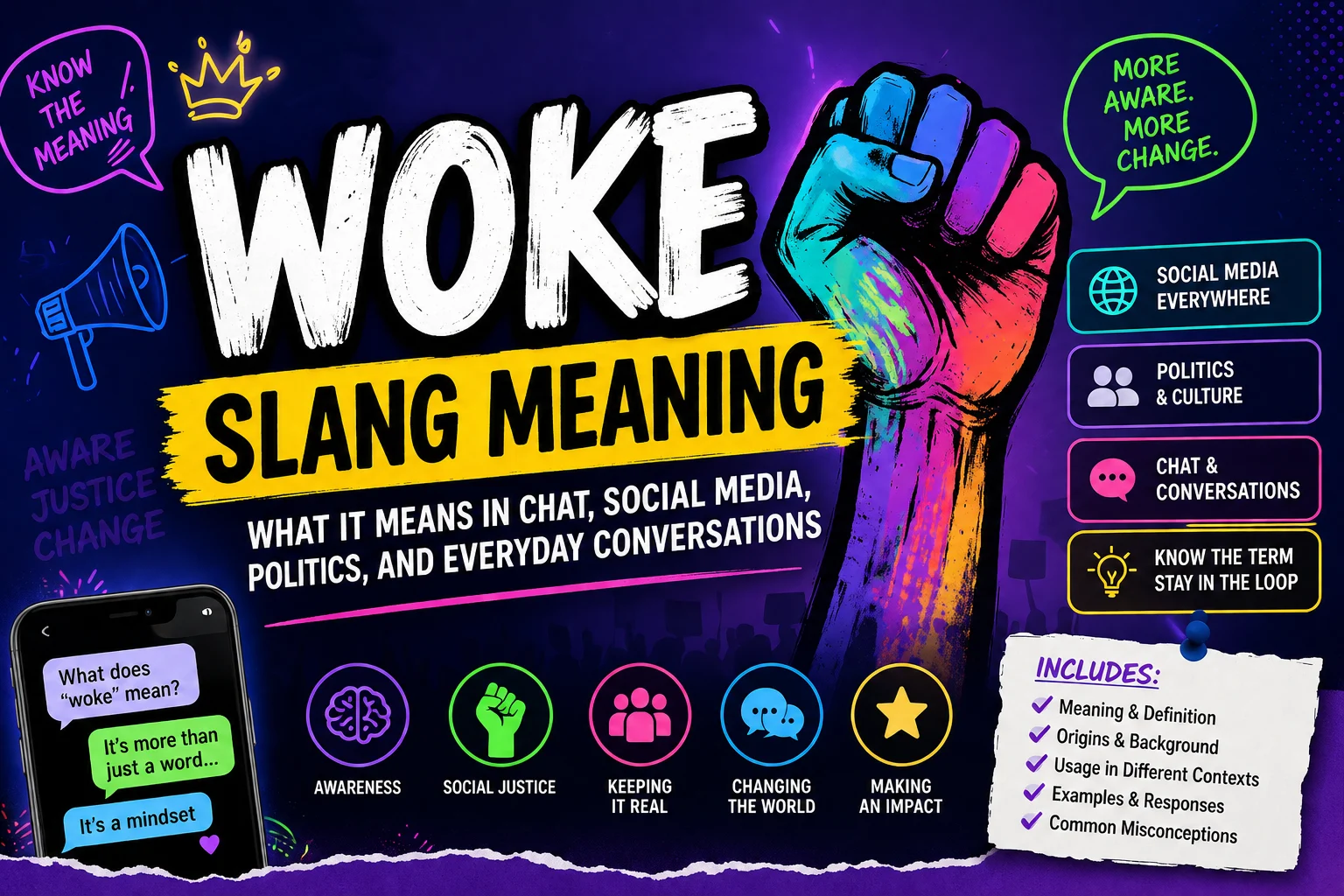
If you’ve seen someone described as “woke” on social media, in news headlines, or during online discussions, you may have wondered what the term actually means. The woke slang meaning has evolved significantly over time, making it one of the most discussed and misunderstood words in modern English. Depending on the context, it can be used as a compliment, a criticism, or simply as a description of someone’s awareness of social issues.
People search for this term because it frequently appears on platforms like TikTok, Instagram, X (formerly Twitter), YouTube, and Facebook. It also appears in political debates, entertainment news, memes, and everyday conversations. Since the word has different interpretations depending on who is using it, understanding its meaning requires looking at both its history and its current usage.
This guide explains what “woke” means, where it came from, how it’s used online and offline, its technical meanings in other fields, common misconceptions, and how to interpret it in different situations.
Meaning & Definition
The most common woke slang meaning refers to someone who is aware of social, political, or cultural issues, particularly those involving inequality, discrimination, or injustice.
Originally, being “woke” meant staying informed and alert about social problems rather than ignoring them.
Examples
Example 1
She’s very woke and supports environmental causes.
Meaning: She is socially aware and actively supports certain issues.
Example 2
Stay woke.
Meaning: Stay informed and pay attention to what’s happening around you.
Today, however, the word is also used sarcastically.
For example:
That’s too woke.
In this context, the speaker may be criticizing something they believe focuses too heavily on social or political issues.
Because of these different uses, the meaning often depends on the speaker’s perspective and the overall conversation.
Background
The term “woke” originated in African American Vernacular English (AAVE), where it meant being awake or alert to racial injustice and social inequality. The expression has been used for decades, with documented examples dating back to the early 20th century.
Its popularity grew significantly during the 2010s, especially through social media and discussions surrounding civil rights, racial equality, and other social movements. The phrase “stay woke” became widely recognized as an encouragement to remain aware of important social issues.
As the word entered mainstream culture, its meaning expanded. News organizations, politicians, businesses, celebrities, and online communities began using “woke” in different ways. Supporters often used it positively to describe awareness and compassion, while critics sometimes used it negatively to describe what they saw as excessive political correctness or activism.
Today, “woke” is one of the most debated slang terms on the internet because its meaning can vary depending on who is speaking and the context in which it is used.
Usage in Different Contexts
The word “woke” has different meanings depending on where you encounter it.
Everyday Conversations
People may use it to describe someone who is socially conscious.
Example:
My friend is very woke about climate change.
Social Media
On social media, “woke” is often used in debates, memes, and opinion posts.
Examples include:
- Stay woke.
- Too woke.
- Woke culture.
- Woke politics.
News and Politics
Journalists and politicians frequently use “woke” when discussing social or cultural issues. Depending on the speaker, the word may carry either a positive or negative tone.
Professional Settings
In workplaces, the slang meaning is generally avoided unless discussing media, culture, marketing, or social issues. In professional communication, it’s better to use more specific terms such as:
- Socially aware
- Inclusive
- Equality-focused
- Diversity-conscious
Meaning in Chat, WhatsApp, Instagram, TikTok
The meaning of “woke” varies slightly across platforms.
Chat & Text Messages
Friends may use it humorously.
Example:
You’re so woke these days.
This could be genuine praise or playful teasing.
In group chats, “woke” often appears during discussions about current events or trending topics.
People use it in captions discussing:
- Social justice
- Environmental awareness
- Equality
- Current events
It may also appear in sarcastic comments.
TikTok
TikTok has popularized both sincere and humorous uses of “woke.”
Examples include:
- Stay woke.
- Woke TikTok.
- Woke or broke?
- Too woke.
Creators may discuss serious issues or make jokes using the term.
X (formerly Twitter)
Political discussions frequently include “woke,” often reflecting differing opinions. Because of this, understanding the surrounding conversation is especially important.
Meaning in Physics, Medical, and Aircraft Terminology
Unlike many abbreviations, “woke” does not have widely recognized technical meanings in these fields.
Physics
There is no standard scientific definition of “woke” in physics. If the word appears, it is almost certainly being used in its everyday English sense.
Medical Field
Medical professionals do not use “woke” as a formal abbreviation. Informally, someone might say a patient “woke up” after surgery or anesthesia, but this simply refers to becoming conscious and is unrelated to the slang meaning.
Aviation
In aviation, “wake”—not “woke”—is a common technical term. For example, wake turbulence refers to air disturbances caused by aircraft. Although the words sound similar, they have completely different meanings.
Other Professional Uses
Outside casual conversation, “woke” rarely appears as technical terminology.
Common Misconceptions
Many misunderstandings surround the word “woke.”
Misconception 1
Woke always refers to politics.
Not necessarily. It can also describe awareness of environmental, cultural, or social issues.
Misconception 2
Being woke always means the same thing.
Its meaning depends on context and the speaker’s viewpoint.
Misconception 3
Woke is always an insult.
Some people use it positively, while others use it critically. Neither interpretation is universal.
Misconception 4
It’s a new internet word.
Although it became widely known through social media, the term has existed for many decades.
Similar Terms & Alternatives
Several words have related meanings.
| Term | Meaning |
|---|---|
| Woke | Socially aware |
| Aware | Informed |
| Conscious | Mindful of issues |
| Progressive | Supporting social reform |
| Inclusive | Welcoming diversity |
| Enlightened | Having deeper understanding |
| Open-minded | Willing to consider different perspectives |
| Socially conscious | Concerned about society |
Each term has its own nuance, and none is an exact substitute for “woke.”
How to Respond to It
How you respond depends on the context.
If someone says:
Stay woke.
You might reply:
- Thanks, I’ll stay informed.
- Absolutely.
- I’ll keep paying attention.
If someone calls you “woke”
Possible responses include:
- What do you mean by that?
- Thanks, if you mean I’m informed.
- Can you explain what you mean?
If you’re unsure
It’s perfectly acceptable to ask:
What do you mean by “woke” in this context?
Clarification helps avoid misunderstandings.
Differences from Similar Words
“Woke” is often confused with other expressions.
| Term | Meaning |
|---|---|
| Woke | Socially aware |
| Aware | Generally informed |
| Conscious | Mindful or alert |
| Liberal | Political viewpoint (in many countries) |
| Progressive | Supporting social change |
| Open-minded | Accepting different ideas |
| Politically correct | Using language intended to avoid offense |
Unlike “aware,” which is broad, “woke” usually relates to social and cultural issues.
Relevance in Online Conversations & Dating Apps
“Woke” remains a common term across social media, discussion forums, and dating platforms. On dating apps, some users mention being “woke” in their profiles to indicate that social values, equality, or activism are important to them. Others may use the word humorously or avoid it altogether because of its varied interpretations.
In online conversations, the term often appears in discussions about current events, entertainment, books, movies, and public figures. Because it can carry different meanings for different people, it’s important not to assume intent based solely on the word itself. Reading the surrounding comments or asking for clarification can help you better understand how it is being used.
Recognizing these nuances allows you to engage in conversations more thoughtfully and avoid unnecessary misunderstandings.
Conclusion
The woke slang meaning has changed over time, evolving from a phrase encouraging awareness of social injustice into a broader and sometimes controversial term used across social media, politics, and everyday conversations. Today, it can describe someone who is socially conscious, serve as praise, or be used critically, depending on the speaker and the context.
Unlike many internet slang words, “woke” has a long history and carries different meanings for different communities. It also has no standard technical meaning in fields like physics, medicine, or aviation, where its everyday definition—or the separate word “wake”—is more likely to apply.
Understanding the context in which “woke” is used is the best way to interpret its meaning accurately. Whether you encounter it in a meme, a news article, or a casual chat, knowing its background and modern usage will help you communicate with greater confidence.
ASL Slang Meaning: What It Means in Chat, Social Media, Dating, and Other Contexts