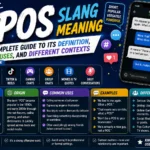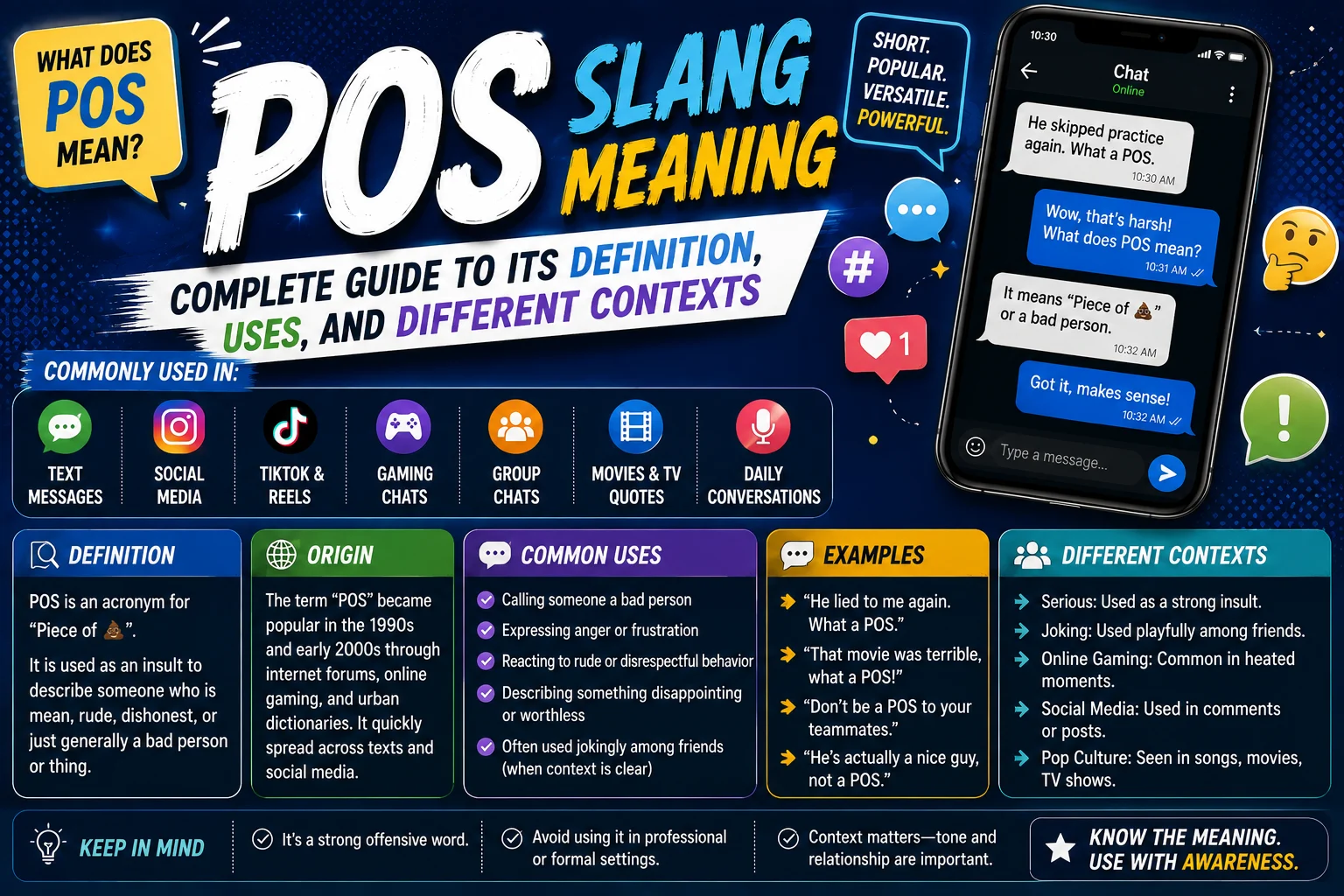
The phrase POS slang meaning is commonly searched because the abbreviation POS can have several meanings depending on where and how it is used. In casual conversations, text messages, social media, gaming, business, medicine, physics, and aviation, the same three letters may represent entirely different ideas. This often leads to confusion, especially when people encounter the term without any context.
In internet slang, POS is most commonly understood as either “Piece of Sh*t” (a vulgar insult) or “Parent Over Shoulder” (a warning that someone’s parent is watching the conversation). However, in professional environments, POS can refer to Point of Sale systems, while technical fields such as medicine and aviation assign completely different meanings to the abbreviation.
Understanding the intended meaning depends on the situation, platform, and audience. This guide explains every major interpretation of POS, where it originated, how it is used today, and how to recognize the correct meaning in conversations.
Meaning & Definition
The POS slang meaning varies depending on the context, but these are the most common definitions:
1. Piece of Sh*t (Most Common Slang)
This is the most widely recognized slang meaning. It is a vulgar insult used to describe someone or something considered terrible, dishonest, unreliable, or extremely poor in quality.
Examples:
- “That old laptop is a POS.”
- “He acted like a POS after the argument.”
In these examples, POS expresses frustration or strong dislike.
2. Parent Over Shoulder
Among teenagers and younger internet users, POS may also mean Parent Over Shoulder. It is used to discreetly tell someone that a parent is nearby and watching the screen.
Example:
- Friend: “Can you talk tonight?”
- Reply: “POS.”
This signals that the conversation should remain appropriate.
3. Point of Sale
Outside internet slang, POS commonly stands for Point of Sale, referring to checkout systems used in retail stores, restaurants, and businesses.
Example:
- “The POS system isn’t processing payments.”
Although this is not slang, it is one of the most common meanings people encounter.
Background
Like many internet abbreviations, POS became popular because it allowed users to communicate quickly while typing fewer characters.
The insulting version, Piece of Sh*t, has existed for decades in spoken English before becoming common in online forums, chat rooms, gaming communities, and text messaging during the early internet era. Users shortened offensive phrases into abbreviations to save time and sometimes avoid automatic content filters.
The alternative meaning, Parent Over Shoulder, appeared later as instant messaging became popular among teenagers. It allowed users to warn friends without alerting nearby parents.
As technology advanced, the abbreviation became even more widespread because business professionals already used POS to refer to Point of Sale systems. Today, one abbreviation serves completely different purposes depending on whether you’re chatting with friends, shopping, working, or reading technical documents.
This variety explains why searches for the meaning of POS continue to increase, as context is essential for interpreting it correctly.
Usage in Different Contexts (Chat, Social Media, Professional Fields)
The meaning of POS changes significantly across different settings.
Casual Chat
Friends often use POS jokingly or critically.
Example:
- “This phone is such a POS.”
Online Gaming
Gamers frequently use POS to criticize teammates, equipment, or opponents.
Example:
- “That weapon is POS.”
Social Media
On platforms like X, Facebook, Reddit, and online forums, POS is commonly used when expressing dissatisfaction with products, services, or public figures.
Example:
- “The update turned the app into a POS.”
Business
In retail, hospitality, and restaurants, POS almost always refers to a Point of Sale terminal or payment system.
Example:
- “We upgraded our POS software.”
Customer Support
Technical support agents regularly discuss POS hardware, payment processing, receipts, and inventory management rather than internet slang.
Knowing the audience helps determine which definition is intended.
Meaning in Chat, WhatsApp, Instagram, TikTok
On messaging apps and social media, POS usually carries informal meanings.
In private conversations:
- Piece of Sh*t
- Parent Over Shoulder
The conversation usually reveals which interpretation fits.
Users may comment:
- “That movie was POS.”
This criticizes the movie rather than referring to business software.
TikTok
TikTok creators often use POS in captions, reaction videos, memes, or story times.
Examples:
- “My old car is POS.”
- “POS 😂”
The abbreviation softens explicit language while keeping the intended meaning obvious.
Snapchat
Among younger users, POS occasionally means Parent Over Shoulder, especially when someone suddenly ends a conversation.
Meaning in Physics, Medical, and Aircraft Terminology
Outside slang, POS has several technical meanings.
Physics
In scientific writing, POS may stand for Position or appear as an abbreviation in specialized equations, research papers, or measurement systems. The exact definition depends on the subject area.
Medical
Medical professionals commonly use POS to mean:
- Positive (test result)
- Postoperative Status
- Other specialty-specific abbreviations depending on the healthcare setting.
Medical abbreviations should always be interpreted within clinical context.
Aircraft and Aviation
In aviation, POS often stands for:
- Position
- Position Report
- Position Information
Pilots, dispatchers, and air traffic personnel may use the abbreviation during navigation or flight operations.
These technical meanings are unrelated to internet slang.
Common Misconceptions
Several misunderstandings surround POS.
Misconception 1: It Always Means an Insult
Not true. In business, POS almost always refers to Point of Sale systems.
Misconception 2: It’s Always Offensive
Only the “Piece of Sh*t” interpretation is vulgar. Other meanings are completely neutral.
Misconception 3: Everyone Uses It the Same Way
Age groups, professions, and online communities often assign different meanings to the abbreviation.
Misconception 4: Context Doesn’t Matter
Context is everything. The same message can mean something entirely different depending on where it appears.
Similar Terms & Alternatives
Depending on the intended meaning, similar abbreviations include:
For “Piece of Sh*t”
- Trash
- Junk
- Garbage
- Worthless
- Terrible
- Cheap
- Broken
For “Parent Over Shoulder”
- POMS
- BRB
- AFK
- GTG
For Business
- Checkout system
- Cash register
- Payment terminal
- Retail software
Choosing the right alternative depends on the conversation.
How to Respond to It
A suitable response depends on which meaning is intended.
If Someone Uses It as an Insult
Example:
- “This computer is POS.”
Possible responses:
- “What happened?”
- “Can it be repaired?”
- “Sounds frustrating.”
If It Means Parent Over Shoulder
Respond respectfully and wait until they are available.
Example:
- “No worries, message me later.”
If It Refers to Point of Sale
Reply professionally.
Example:
- “Is the POS system showing any error messages?”
Matching your response to the context prevents misunderstandings.
Differences from Similar Words
POS differs from several commonly confused abbreviations.
| Abbreviation | Common Meaning | Typical Context |
|---|---|---|
| POS | Piece of Sh*t, Parent Over Shoulder, Point of Sale | Slang, messaging, business |
| POV | Point of View | Social media, videos |
| OP | Original Poster or Overpowered | Forums, gaming |
| DM | Direct Message | Social media |
| AFK | Away From Keyboard | Gaming, chat |
| BRB | Be Right Back | Messaging |
Although these abbreviations often appear together online, they have entirely different meanings.
Relevance in Online Conversations & Dating Apps
POS appears regularly across modern digital communication.
On dating apps, someone might describe a bad date by saying:
“He turned out to be a POS.”
Here, the abbreviation expresses disappointment or criticism.
In online communities, people also use POS when reviewing products, discussing customer service, or sharing negative experiences.
Meanwhile, younger users may still rely on Parent Over Shoulder to discreetly signal that someone nearby is monitoring their conversation.
Because abbreviations save time and reduce typing, POS continues to be part of internet culture across messaging apps, gaming platforms, forums, and social media. Understanding the surrounding conversation remains the best way to identify its intended meaning.
Conclusion
Understanding the POS slang meaning requires paying close attention to context. While many people immediately associate POS with “Piece of Sh*t,” the abbreviation can also mean “Parent Over Shoulder” in online chats or “Point of Sale” in business settings. Technical fields such as medicine, physics, and aviation have their own specialized definitions as well.
Rather than assuming a single interpretation, consider who is speaking, where the conversation is taking place, and what topic is being discussed. This simple approach helps avoid misunderstandings and ensures accurate communication. As online language continues to evolve, abbreviations like POS remain popular because they are short, convenient, and versatile. Whether you’re reading a text message, browsing social media, working in retail, or studying technical material, knowing the different meanings of POS allows you to understand conversations more confidently and respond appropriately.
Lit Slang Meaning: What Does “Lit” Mean in Modern Conversations and Online Culture?

I am a professional content writer with a passion for English grammar, slang, vocabulary, and everyday language. I specialize in creating clear, engaging, and easy-to-understand articles about grammar rules, slang meanings, phrases, expressions, and modern English usage. My goal is to help readers understand language better, communicate naturally, and use English with confidence.