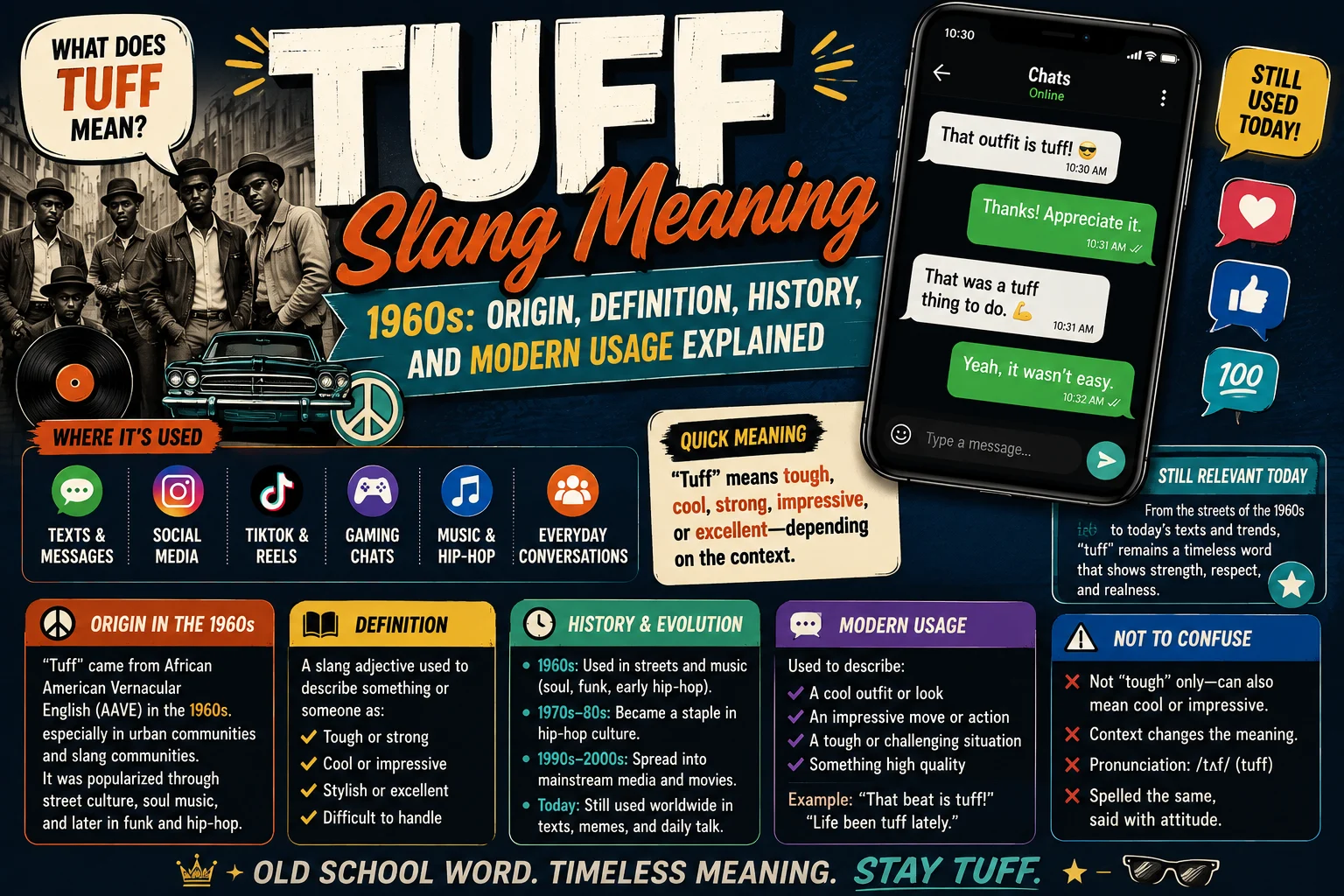
The phrase tuff slang meaning 1960s is often searched by people reading old books, listening to classic songs, watching vintage movies, or exploring American pop culture. While “tuff” looks like a simple misspelling of “tough,” it carried its own style and cultural meaning during the 1960s. Teenagers, musicians, and writers sometimes used tuff to describe someone who was cool, fearless, street-smart, or rebellious. The spelling also became popular in advertising, entertainment, and youth culture because it looked modern and memorable.
Today, many people come across the word on social media, in classic literature, or in titles like The Outsiders, where similar slang reflects teenage life in the 1960s. Others wonder whether tuff has the same meaning in texting, professional fields, or technical subjects such as geology, medicine, or aviation.
This guide explains the meaning of tuff in the 1960s, its background, how it is used today, where confusion comes from, and how its meaning changes depending on the context.
Meaning & Definition
In 1960s slang, tuff was an alternative spelling of tough, but it often carried a stronger sense of style, confidence, and youthful identity. Instead of simply describing someone as physically strong, the word could mean someone who was brave, cool, independent, or difficult to intimidate.
Young people frequently used the word to compliment friends or describe people with confidence and attitude.
Common meanings included:
- Strong or fearless
- Cool and impressive
- Street-smart
- Hard to defeat
- Confident under pressure
Examples
- “He’s really tuff.”
- “That biker looks tuff.”
- “She has a tuff attitude.”
Although the spelling differed, listeners understood it as the same pronunciation as tough.
Today, dictionaries usually treat tuff as an informal or stylized spelling rather than a separate slang word.
Background
Understanding the tuff slang meaning 1960s requires looking at American youth culture during that decade.
The 1960s saw dramatic changes in music, fashion, civil rights, and teenage identity. Young people wanted words that felt different from traditional English. Creative spellings became popular because they looked modern and rebellious.
“Tuff” appeared in:
- Teen magazines
- Rock and roll culture
- Advertising campaigns
- Movie titles
- Comic books
- Street slang
Businesses also liked the spelling because it was short, catchy, and memorable.
The popularity of customized spellings continued into later decades with words like:
- Kool
- Nite
- Lite
- Xtreme
The alternative spelling made ordinary words feel exciting without changing their pronunciation.
Outside slang, tuff already existed as a geological term describing volcanic rock, although that meaning is completely unrelated to youth slang.
Usage in Different Contexts
Although tuff began as a slang spelling, its meaning changes depending on where it appears.
Everyday conversation
People may use it humorously or stylistically.
Example:
“That was a tuff workout.”
Online writing
Some users intentionally spell tough as tuff for emphasis or personality.
Example:
“Life has been tuff lately.”
Branding
Companies sometimes use tuff in product names because it sounds durable.
Examples include:
- Tuff tools
- Tuff bags
- Tuff cases
Entertainment
The spelling appears in music, sports, gaming, and fashion to create a rugged image.
Professional writing
Professional documents almost always use tough instead of tuff, unless referring to a brand or a geological material.
Meaning in Chat, WhatsApp, Instagram, and TikTok
On modern social media, tuff has evolved beyond its 1960s roots.
Young users often type tuff instead of tough because it feels casual and expressive.
Examples include:
- “That beat is tuff.”
- “Your outfit is tuff.”
- “This game is tuff.”
- “That edit is tuff.”
Depending on context, it can mean:
- Excellent
- Stylish
- Difficult
- Impressive
- Powerful
Friends often use it in casual conversations.
Example:
“Your new car looks tuff!”
It commonly praises:
- Fashion
- Cars
- Fitness
- Photography
TikTok
Creators often use tuff to describe:
- Amazing videos
- Strong performances
- Difficult challenges
- Impressive skills
The positive meaning is now far more common than the original 1960s usage.
Meaning in Physics, Medical, and Aircraft Terminology
The word tuff can also appear in technical fields, where it has completely different meanings.
Physics
Physics itself does not use tuff as a technical term. When it appears, it is usually discussing geological materials during scientific research.
Geology
In geology, tuff is a type of rock formed from volcanic ash that becomes solid after an eruption.
Example:
“The volcano produced thick layers of tuff.”
This is the official scientific meaning of the word.
Medical
Medicine does not use tuff as a standard medical term.
If seen in healthcare, it is usually:
- A brand name
- A typing error
- A patient’s informal spelling of “tough”
Aircraft
Aircraft engineering does not recognize tuff as standard aviation terminology.
However, companies sometimes include Tuff in product names to suggest durability.
Common Misconceptions
Many people misunderstand the word because it has multiple meanings.
Misconception 1
“Tuff is always incorrect.”
Not true.
It is correct when referring to volcanic rock, certain brand names, or intentional slang.
Misconception 2
“Tuff is official English.”
Usually, standard English prefers tough.
Misconception 3
“Tuff only belongs to the 1960s.”
While it became popular then, it remains common in modern internet slang.
Misconception 4
“Tuff always means difficult.”
It can also mean cool, impressive, or stylish.
Similar Terms & Alternatives
Several words share similar meanings depending on context.
| Word | Meaning |
|---|---|
| Tough | Standard spelling |
| Strong | Physically powerful |
| Rugged | Durable |
| Hard | Difficult |
| Cool | Impressive |
| Awesome | Excellent |
| Bad (slang) | Surprisingly good |
| Fire (slang) | Outstanding |
Choosing the right word depends on your audience and tone.
How to Respond to It
If someone calls something tuff, your response depends on the situation.
If it means “cool”
“Thanks!”
“I appreciate that.”
“Glad you liked it.”
If it means “difficult”
“I know—it wasn’t easy.”
“It took a lot of work.”
If you’re unsure
Ask politely:
“What do you mean by tuff?”
Context usually makes the intended meaning clear.
Differences from Similar Words
Although they look alike, these words are not identical.
| Word | Meaning |
|---|---|
| Tough | Standard English adjective |
| Tuff | Informal spelling or geological rock |
| Rough | Uneven or harsh |
| Hard | Difficult or solid |
| Durable | Long-lasting |
| Strong | Powerful |
The biggest difference is that tough belongs in formal writing, while tuff is mainly stylistic, slang, or technical geology.
Relevance in Online Conversations & Dating Apps
The tuff slang meaning 1960s still influences modern internet language.
On dating apps, people may say:
- “She’s tuff.”
- “He’s tuff.”
Usually this means:
- Confident
- Attractive
- Cool
- Stylish
- Hard to impress
On gaming platforms, Discord, Reddit, Instagram, and TikTok, tuff often describes:
- Great gameplay
- Excellent music
- Attractive fashion
- Impressive skills
- Memorable moments
Unlike its original use, today’s online meaning is usually positive and complimentary rather than simply describing someone as physically tough.
Conclusion
The tuff slang meaning 1960s reflects an era when young people reshaped language to express identity, confidence, and independence. While it started as a creative spelling of tough, it quickly became associated with coolness, resilience, and a rebellious attitude. Over time, its use expanded beyond youth slang into branding, entertainment, and eventually internet culture.
Today, tuff still appears in text messages, social media posts, music, and online conversations. In most casual settings, it means something impressive, stylish, or exceptionally good. However, in formal writing, the standard spelling tough remains the correct choice. It’s also important to remember that tuff has an entirely separate scientific meaning in geology, referring to volcanic rock.
Understanding the context is the key to interpreting the word correctly. Whether you’re reading classic 1960s literature, scrolling through TikTok, or studying geology, knowing the different meanings of tuff helps you communicate clearly and avoid confusion.
Gas Slang Meaning: What It Means in Chat, TikTok, Instagram, Music, and Everyday Conversations

I am a professional content writer with a passion for English grammar, slang, vocabulary, and everyday language. I specialize in creating clear, engaging, and easy-to-understand articles about grammar rules, slang meanings, phrases, expressions, and modern English usage. My goal is to help readers understand language better, communicate naturally, and use English with confidence.