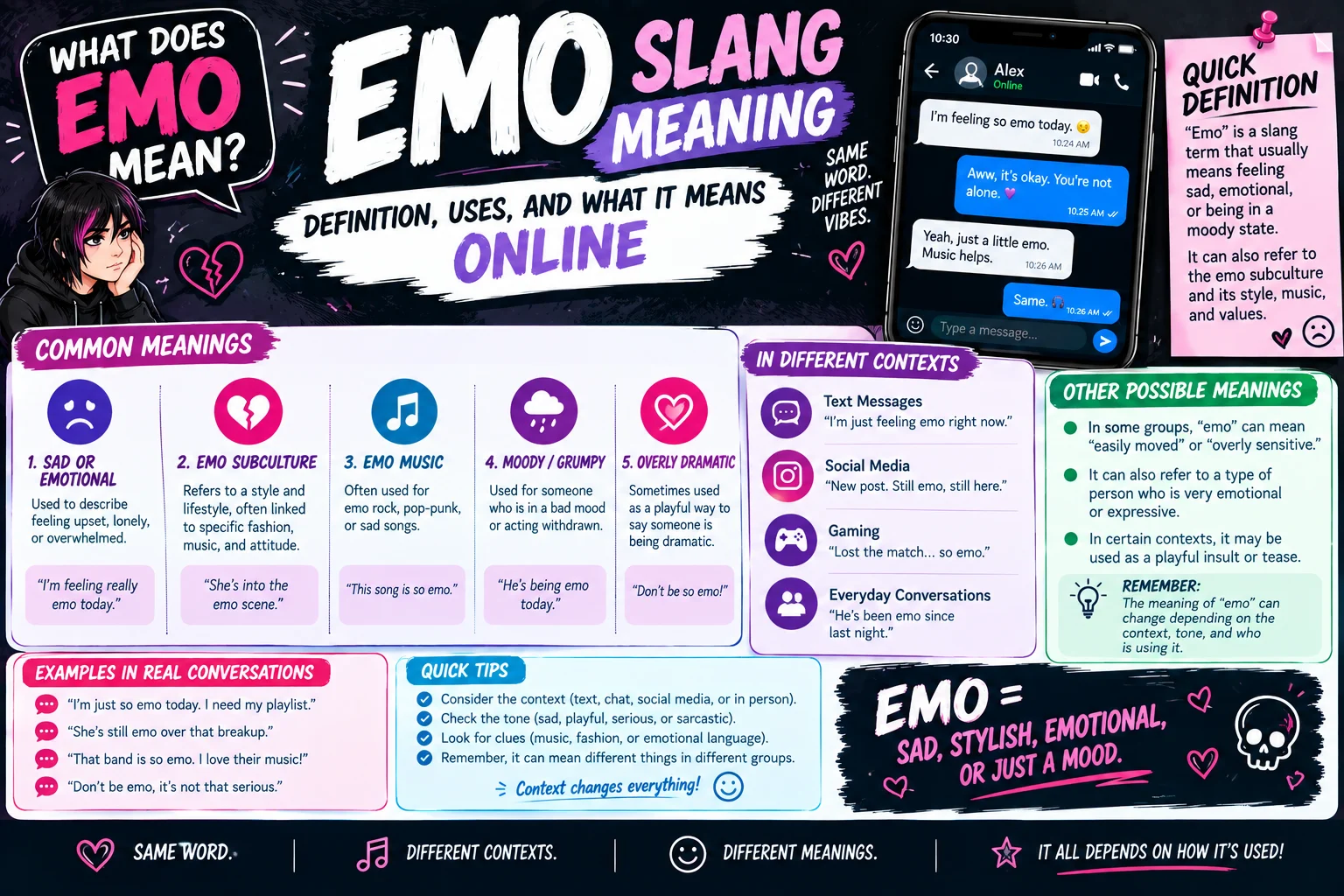
Have you seen someone called “emo” in a chat, comment, or social media post and wondered what it really means? The search for emo slang meaning has grown because the word is used in many different ways today. Some people use it to describe emotions, while others connect it with music, fashion, personality, or online identity.
The meaning can change depending on the situation. A person saying “I’m feeling emo” may simply mean they feel emotional or sensitive. Someone describing a style as “emo” may be referring to a music and fashion culture that started decades ago.
Understanding this slang helps people communicate better, especially on platforms like Instagram, TikTok, WhatsApp, and dating apps where short words can carry different meanings. This guide explains what “emo” means, where it came from, how people use it today, and how to understand it in different situations.
Emo Slang Meaning: Definition and Explanation
The word emo is a slang term that originally came from the word emotional. Today, it has several meanings depending on context.
In casual conversations, “emo” often describes someone who is:
- Very emotional
- Sensitive or thoughtful
- Expressing sadness or deep feelings
- Reflecting on personal experiences
For example:
- “I’m feeling emo today” can mean “I feel emotional or a little sad.”
- “That song made me emo” means the song created strong emotions.
However, emo is also connected to a specific cultural movement. The emo subculture developed around music that focused on personal feelings, relationships, struggles, and self-expression. It became associated with certain clothing styles, hairstyles, and artistic choices.
Modern internet use has made the word broader. A person does not have to follow the emo music scene to be called emo. Online, people often use it casually to describe emotional moments, dramatic reactions, or deep thoughts.
The meaning depends heavily on tone. It can be playful, serious, or even negative depending on who says it and why.
Background and History of Emo
The history of emo goes back to music culture. The term first appeared in the 1980s as a short form of “emotional hardcore,” describing a style of punk rock that focused more on personal feelings and expressive lyrics.
Over time, emo music developed through different stages. Bands began creating songs about relationships, identity, personal struggles, and emotional experiences. During the early 2000s, emo became widely popular among young audiences.
The culture expanded beyond music into:
- Fashion
- Hairstyles
- Online communities
- Art
- Personal expression
Traditional emo style was often associated with:
- Dark clothing
- Band shirts
- Long hairstyles
- Creative self-expression
As social media grew, the word changed again. Platforms like TikTok and Instagram helped transform “emo” from a specific music identity into a general slang term.
Today, someone might say:
- “I’m in my emo era.”
- “This playlist is so emo.”
- “That message was emo.”
These phrases may not refer to the original music movement. Instead, they often describe a mood, aesthetic, or emotional state.
Usage in Different Contexts
Emo Meaning in Chat, WhatsApp, Instagram, and TikTok
In online conversations, emo is often used casually.
Examples:
WhatsApp:
- “Why are you so emo today?”
- Meaning: Why are you acting emotional or sad?
Instagram:
- “This picture gives emo vibes.”
- Meaning: The image has a deep, emotional, or dark style.
TikTok:
- “I’m entering my emo phase.”
- Meaning: I am exploring a more emotional style or mood.
On social media, the word is often playful rather than a serious label. People may use it to describe a song, outfit, video, or personal feeling.
Emo in Professional Fields
In professional communication, “emo” is uncommon because it is informal slang. A workplace email would normally use clearer words such as:
- Emotional
- Sensitive
- Reflective
- Upset
- Thoughtful
For example:
Informal:
- “He’s being emo today.”
Professional:
- “He seems emotionally affected by the situation.”
Using slang in professional settings may create confusion because not everyone understands internet expressions.
Emo Meaning in Physics, Medical, and Aircraft Terminology
The word “emo” can have different meanings outside slang, depending on the field.
Physics
“Emo” is not a common standard physics term. If someone encounters it in a scientific context, it may be an abbreviation, acronym, or a specialized term specific to a research area.
Medical Field
In medicine, “emo” is not commonly used as a general medical term. Medical professionals usually use specific terms related to emotions, mental health, or conditions rather than slang expressions.
Aircraft Terminology
“Emo” is not a standard aviation term. If found in aviation documents, it may refer to an organization, abbreviation, or technical code rather than the slang meaning.
Because “emo” has different possible meanings, context is important. A conversation about feelings is very different from a technical document.
Common Misconceptions About Emo
Many people misunderstand the meaning of emo because the word has changed over time.
Misconception 1: Emo Always Means Sad
While emo is connected with emotional expression, it does not only mean sadness.
Someone can be emo because they are:
- Deeply thoughtful
- Passionate
- Expressive
- Reflective
Misconception 2: Emo Is Only a Fashion Style
Fashion is one part of emo culture, but the original meaning was strongly connected with music and emotional expression.
Misconception 3: Calling Someone Emo Is Always an Insult
The meaning depends on tone. Friends may use it jokingly, while others may use it negatively.
Misconception 4: Emo and Depression Are the Same
They are not the same. Emo is a style, mood, or form of expression. Depression is a serious mental health condition that involves specific symptoms and requires proper understanding.
Similar Terms and Alternatives
Several words are related to emo but have different meanings.
| Term | Meaning |
|---|---|
| Emotional | Feeling strong emotions |
| Sensitive | Easily affected by feelings |
| Moody | Changing between different moods |
| Melancholy | A thoughtful or gentle sadness |
| Dramatic | Showing strong reactions |
| Goth | A culture linked with dark fashion and themes |
While emo and goth are sometimes confused, they are different. Emo is historically connected with emotional music and expression, while goth developed from a different music and artistic movement.
How to Respond When Someone Says Emo
The best response depends on the situation.
If someone says:
“I’m feeling emo today.”
You could reply:
- “What happened?”
- “Hope you feel better.”
- “Want to talk about it?”
If someone jokes:
“You’re so emo.”
Possible responses:
- “Haha, maybe I am.”
- “Just feeling things deeply.”
- “It’s my emotional playlist moment.”
Understanding the tone helps you respond appropriately.
Differences Between Emo and Similar Words
| Word | Main Meaning | Example |
|---|---|---|
| Emo | Emotional style, mood, or culture | “This song feels emo.” |
| Sad | Feeling unhappy | “I feel sad today.” |
| Depressed | Serious mental health condition | “He is receiving support for depression.” |
| Sensitive | Easily affected emotionally | “She is very sensitive.” |
| Dramatic | Strong reaction | “That response was dramatic.” |
The key difference is that emo is often about expression and style, while other words describe specific emotions or conditions.
Emo Meaning in Online Conversations and Dating Apps
On dating apps, people may use “emo” to describe personality, style, or interests.
Examples:
- “Looking for someone who loves emo music.”
- Meaning: Interested in the music culture.
- “I’m a little emo.”
- Meaning: I am emotional, thoughtful, or expressive.
- “Emo vibes only.”
- Meaning: A preference for a certain aesthetic or mood.
In online dating, the word can suggest someone who values creativity, deep conversations, music, or emotional openness.
However, people should avoid making assumptions based only on the label. Someone using the word “emo” may simply enjoy the style or music, not necessarily have a specific personality type.
Conclusion
The meaning of “emo” has changed greatly over time. It began as a term connected with emotional music but has grown into a popular slang word used online, in conversations, and across social media platforms.
Today, emo slang meaning depends on context. It can describe a mood, a style, a personality trait, or an interest in a specific music culture. While people often use it to mean emotional or sensitive, it does not automatically mean someone is sad or negative.
Understanding modern slang helps prevent confusion in digital communication. Whether you see “emo” in a WhatsApp message, TikTok caption, Instagram comment, or dating profile, look at the surrounding words and situation. The meaning usually comes from the person’s intention and the conversation itself.
FN Slang Meaning: Complete Guide to Its Definition, Uses, and Online Contexts

I am a professional content writer with a passion for English grammar, slang, vocabulary, and everyday language. I specialize in creating clear, engaging, and easy-to-understand articles about grammar rules, slang meanings, phrases, expressions, and modern English usage. My goal is to help readers understand language better, communicate naturally, and use English with confidence.