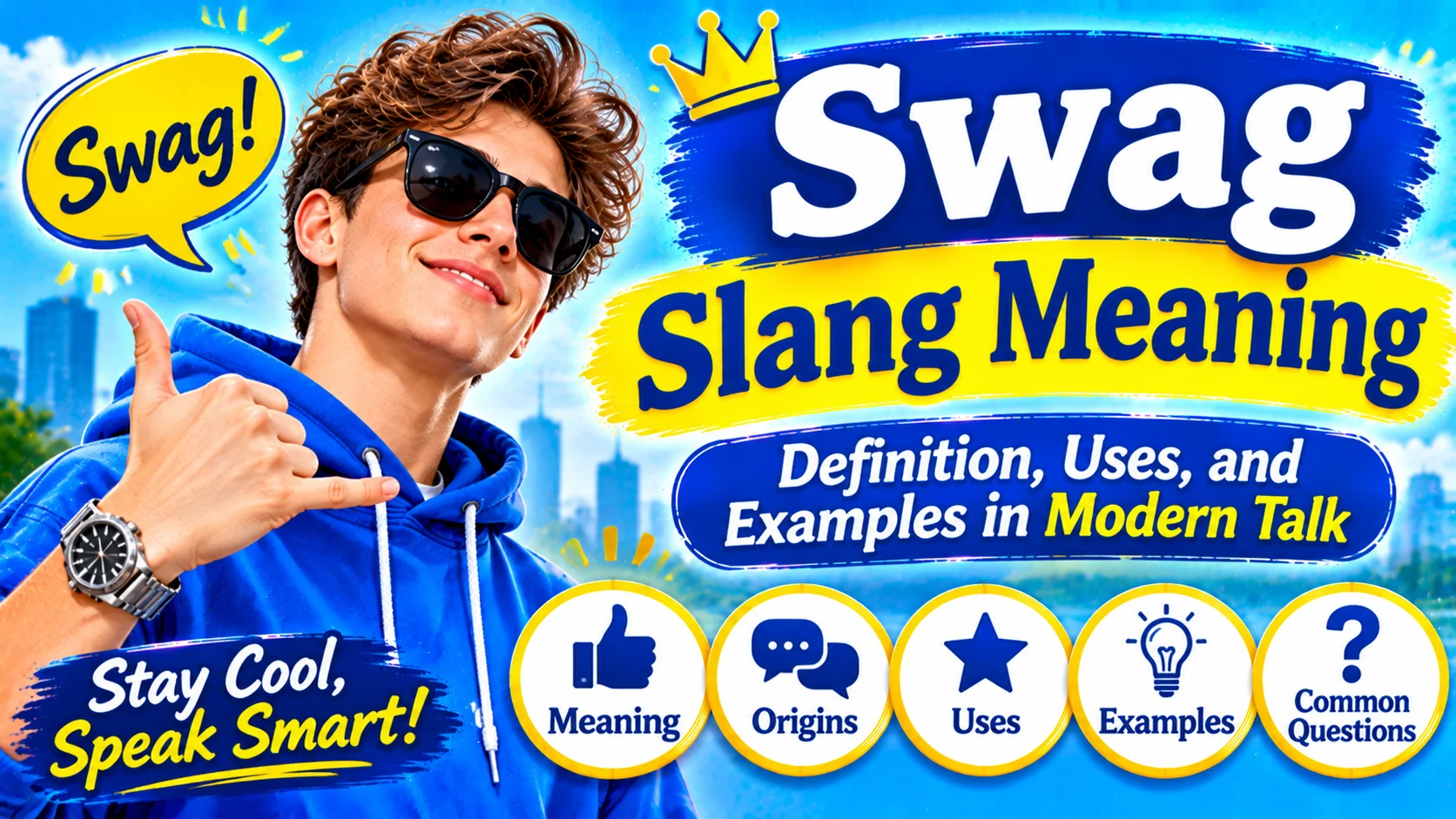
If you have seen someone write “swag” in a text, Instagram caption, TikTok comment, or casual conversation, you may wonder what they actually mean. The word has been around for a long time, but its modern slang meaning is closely associated with confidence, personal style, charisma, and an effortlessly cool attitude.
People search for swag slang meaning because the word can describe several related ideas depending on the situation. Someone might say, “He has swag,” to compliment a person’s appearance or confidence. A friend might use “swag” jokingly, while a brand may use it to describe promotional merchandise.
The word can also be confusing because SWAG appears as an acronym in professional and technical contexts. Those meanings are generally unrelated to the slang use.
Understanding the context is therefore important. Whether you encounter “swag” in a WhatsApp message, dating app, social-media post, workplace conversation, or technical document, the intended meaning can change.
Meaning & Definition
In modern informal English, swag generally refers to a person’s style, confidence, charisma, or cool way of presenting themselves.
When someone says, “You’ve got swag,” they are usually giving a compliment. They may be saying that you look fashionable, carry yourself confidently, or have a distinctive personality that makes you stand out.
For example:
- “That outfit has serious swag.”
- “He walks into every room with swag.”
- “She has so much swag.”
- “Your new shoes are pure swag.”
In these examples, the word doesn’t necessarily refer to one specific physical characteristic. It can describe an overall impression.
Swag is often associated with confidence, but confidence and swag are not exactly the same thing. Confidence refers more directly to belief in yourself or your abilities. Swag adds an element of style, attitude, or social presence.
The word can also be used humorously or ironically. Someone might describe an intentionally exaggerated outfit as having “maximum swag,” even when they are clearly joking.
Another meaning of “swag” is free promotional merchandise. Businesses sometimes give customers or event attendees branded products such as T-shirts, pens, bags, stickers, or water bottles. In this context, “swag” isn’t slang describing someone’s personality.
Therefore, the surrounding sentence is essential for understanding the intended meaning.
Background and History
The history of swag is more complicated than its modern slang usage might suggest.
The word has existed in English for centuries, with historical meanings connected to things such as a hanging or drooping appearance and, in some uses, goods or belongings. Over time, different forms of the word developed in different varieties of English.
The modern slang sense became particularly prominent during the late 20th and early 21st centuries. Music, entertainment, fashion, advertising, and youth culture helped spread the idea of “swag” as a combination of confidence, style, and individuality.
Hip-hop and popular music played an especially important role in making the contemporary sense widely recognizable. As the term became more mainstream, it moved beyond music and began appearing in advertising, social media, everyday conversations, and fashion discussions.
The word’s popularity has also produced playful variations and related expressions. People may describe someone as “swaggy,” talk about having “swag,” or use the word ironically.
At the same time, another meaning developed in business culture. “Swag” became widely used to describe free branded merchandise distributed at conferences, events, product launches, and promotional campaigns.
This creates an interesting linguistic situation: the same word can refer to personal style in one sentence and promotional products in another.
For example:
“She has amazing swag.”
Here, swag means style or confidence.
“We collected some swag at the conference.”
Here, swag means promotional merchandise.
The history of the word explains why context remains so important.
Usage in Different Contexts
The way people use swag varies considerably depending on the setting.
Casual Conversation
In everyday speech, swag is usually a compliment related to someone’s style, confidence, or attitude.
Chat and Texting
Friends may use it casually, jokingly, or sarcastically. The meaning may be reinforced by emojis such as 😎, 🔥, or 😂.
Social Media
On Instagram and TikTok, swag often appears in captions about fashion, confidence, dancing, music, or lifestyle. It can be sincere or deliberately humorous.
Fashion
In fashion-related conversations, swag may describe an outfit or overall personal aesthetic. Someone with distinctive clothing may be described as having “swag.”
Business and Marketing
Companies commonly use “swag” to refer to promotional merchandise. Conference attendees may receive branded shirts, mugs, notebooks, tote bags, or other items.
Professional Communication
The slang version is generally informal and may not be suitable for formal reports or official correspondence. However, the acronym SWAG may have specialized meanings in technical, business, or scientific environments.
The same four letters therefore require different interpretations depending on the audience and subject.
Swag Meaning in Chat, WhatsApp, Instagram, and TikTok
In online conversations, swag most commonly carries its modern informal meaning: style, confidence, coolness, or a distinctive attitude.
On WhatsApp, a friend might send:
“Bro, you’ve got swag 😎.”
This is generally a compliment. The person may be praising your outfit, confidence, hairstyle, personality, or overall appearance.
On Instagram, “swag” frequently appears in captions related to fashion and lifestyle. A person posting a stylish photograph might use the word to emphasize confidence or individuality.
TikTok uses the term in a similarly flexible way. It can appear in videos about clothing, dancing, music, humor, or personality. Because TikTok trends change quickly, the exact tone can range from genuine admiration to playful irony.
The word can also be used sarcastically.
For example, someone wearing an intentionally ridiculous outfit might post:
“Too much swag for one photo 😂.”
Here, the speaker isn’t necessarily claiming to be genuinely fashionable. The humor comes from exaggerating the idea.
Emojis can help clarify the intended tone:
- 😎 often suggests confidence or coolness.
- 🔥 can indicate admiration for someone’s appearance or style.
- 😂 may indicate that “swag” is being used jokingly.
- ❤️ can make the compliment feel warmer or more personal.
Still, emojis aren’t definitive. The safest interpretation comes from the entire conversation.
Swag Meaning in Physics, Medical, and Aircraft Terminology
When SWAG appears in a scientific, medical, aviation, or engineering context, it may have nothing to do with slang.
This is an important distinction because technical fields frequently use abbreviations and acronyms that happen to resemble ordinary words.
In technical writing, the exact meaning of an acronym depends on the discipline, organization, document, and subject being discussed.
For example, in some professional environments, SWAG may be used informally as an acronym for a rough or approximate estimate. One commonly encountered expansion is “Scientific Wild-Ass Guess,” although wording can vary depending on the organization. This is informal terminology rather than a precise scientific method.
In medicine, terminology is particularly sensitive because abbreviations can vary between institutions and specialties. A reader should not guess the meaning of an unfamiliar medical abbreviation when the interpretation could affect treatment or patient safety.
Aviation and aircraft terminology also contains extensive abbreviations covering aircraft systems, operations, organizations, procedures, and equipment. The exact document or communication channel matters when interpreting an unfamiliar acronym.
Physics papers and engineering documents may introduce abbreviations specific to a research group or technical system. Medical organizations can also use abbreviations that are meaningful only within a particular specialty or institution.
Therefore, if you encounter SWAG in a technical document, look at its first occurrence, glossary, abbreviation list, or the documentation provided by the relevant organization.
This is particularly important in medicine and aviation, where misunderstanding an abbreviation can have serious consequences.
In short, slang “swag” and technical “SWAG” should be treated as separate possibilities until the context establishes otherwise.
Common Misconceptions About Swag
One common misconception is that swag always means confidence.
While confidence is an important part of the modern slang meaning, swag can also refer to fashion, charisma, attitude, or an overall sense of coolness.
Another misconception is that swag necessarily means expensive clothing.
It doesn’t. Someone can have swag without wearing designer brands. The slang meaning is often more about how a person presents themselves than how much their clothes cost.
People also sometimes assume that swag is always a serious compliment. Not necessarily. The word is frequently used jokingly or sarcastically, especially online.
Another source of confusion is the promotional meaning of swag. When a company says, “We have free swag,” it usually means branded merchandise rather than personal style.
Finally, SWAG in uppercase letters does not automatically indicate slang. Capitalization can signal an acronym, particularly in professional or technical writing.
The surrounding context is therefore more useful than capitalization alone.
Similar Terms and Alternatives
Several words overlap with the modern slang meaning of swag, although each has its own nuance.
Style
“Style” usually refers to someone’s fashion choices, appearance, or distinctive way of presenting themselves. It is broader and more neutral than swag.
Confidence
Confidence focuses on self-belief and assurance. Someone can be highly confident without necessarily having a fashionable or charismatic style.
Charisma
Charisma describes a person’s ability to attract attention or influence others through personality and presence.
Coolness
“Cool” is perhaps one of the closest informal alternatives, although its meaning is broader.
Flair
“Flair” suggests a distinctive, expressive, or stylish quality.
Drip
“Drip” is newer internet slang that usually focuses strongly on fashionable clothing or accessories.
Sauce
“Sauce” can informally describe a person’s distinctive style, energy, or confidence.
These words overlap, but they are not perfect synonyms. The best choice depends on whether you’re talking about appearance, confidence, personality, or overall presence.
How to Respond to “Swag”
If someone tells you “You have swag,” they are usually complimenting you.
You can respond naturally depending on your personality:
Casual:
“Thanks! 😎”
Playful:
“I try my best 😂.”
Confident:
“You already know!”
Humble:
“Appreciate it!”
Flirty:
“Glad you noticed 😉.”
If someone uses “swag” sarcastically, matching their humor can make the conversation smoother.
For example:
Them: “Look at all this swag 😂.”
You: “Too much for one person!”
If you’re unsure whether someone is complimenting you, you can simply ask:
“Haha, is that a compliment?”
That keeps the conversation light while giving the other person an opportunity to explain.
Differences From Similar Words
Although swag, drip, style, rizz, and confidence can appear in similar conversations, they aren’t interchangeable.
Swag generally describes a combination of style, confidence, attitude, and coolness.
Drip is more specifically associated with fashionable clothing, accessories, or an impressive outfit.
Rizz refers primarily to charm or someone’s ability to attract or flirt successfully.
Confidence means belief in one’s own abilities or qualities. It doesn’t necessarily involve fashion or social charisma.
Style is a broader and more neutral term for a person’s distinctive appearance or way of doing something.
Consider the difference:
- “He has great style.” → His appearance or fashion choices are distinctive.
- “He has serious swag.” → He has style combined with confidence and attitude.
- “Her outfit has drip.” → Her clothing looks particularly fashionable.
- “He has plenty of rizz.” → He is charming or effective at flirting.
- “She has strong confidence.” → She believes in herself.
Understanding these distinctions makes modern online language much easier to interpret.
Swag in Online Conversations and Dating Apps
On dating apps, swag can have a slightly more personal meaning because conversations often involve appearance, confidence, personality, and attraction.
If someone says, “You have swag,” they may be complimenting your photographs, clothing, confidence, or overall personality.
The statement is generally positive, but it doesn’t necessarily mean the person is romantically interested. Context matters.
For example:
“Your outfit has swag 🔥.”
This is primarily a fashion compliment.
Meanwhile:
“I like your swag. You seem really confident.”
This compliments both personality and presentation.
And:
“That profile has some serious swag 😂.”
This could be playful rather than genuinely flirtatious.
On dating apps, slang also helps create a relaxed tone. People may use informal words because they want the conversation to feel less formal and more playful.
If someone compliments your swag and you are interested, you can respond by returning the energy:
“Thanks 😎 I like your style too.”
If you’re unsure of their intentions, keep your response friendly and let the conversation develop naturally.
Online communication often leaves out facial expressions and vocal tone, so clarification can prevent unnecessary misunderstandings.
Conclusion
The modern swag slang meaning is primarily connected with style, confidence, charisma, attitude, and an effortlessly cool presence. It is commonly used as a compliment in casual conversations, text messages, social media posts, and dating-app chats.
However, swag isn’t limited to slang. In business, “swag” can refer to free promotional merchandise, while SWAG may function as an acronym in certain professional or technical environments.
The best way to understand the word is therefore to consider the context. If someone says you have swag, they’re probably praising your style or confidence. If a company mentions event swag, they’re probably talking about branded freebies. If SWAG appears in a technical document, consult the relevant terminology rather than assuming it means “cool.”
Language constantly evolves, and slang changes particularly quickly online. Fortunately, the core idea behind modern swag is simple: it’s about the way someone carries and expresses themselves.
IMO Slang Meaning: Complete Guide to Its Definition, Usage, Examples, and Different Meanings

I am a professional content writer with a passion for English grammar, slang, vocabulary, and everyday language. I specialize in creating clear, engaging, and easy-to-understand articles about grammar rules, slang meanings, phrases, expressions, and modern English usage. My goal is to help readers understand language better, communicate naturally, and use English with confidence.