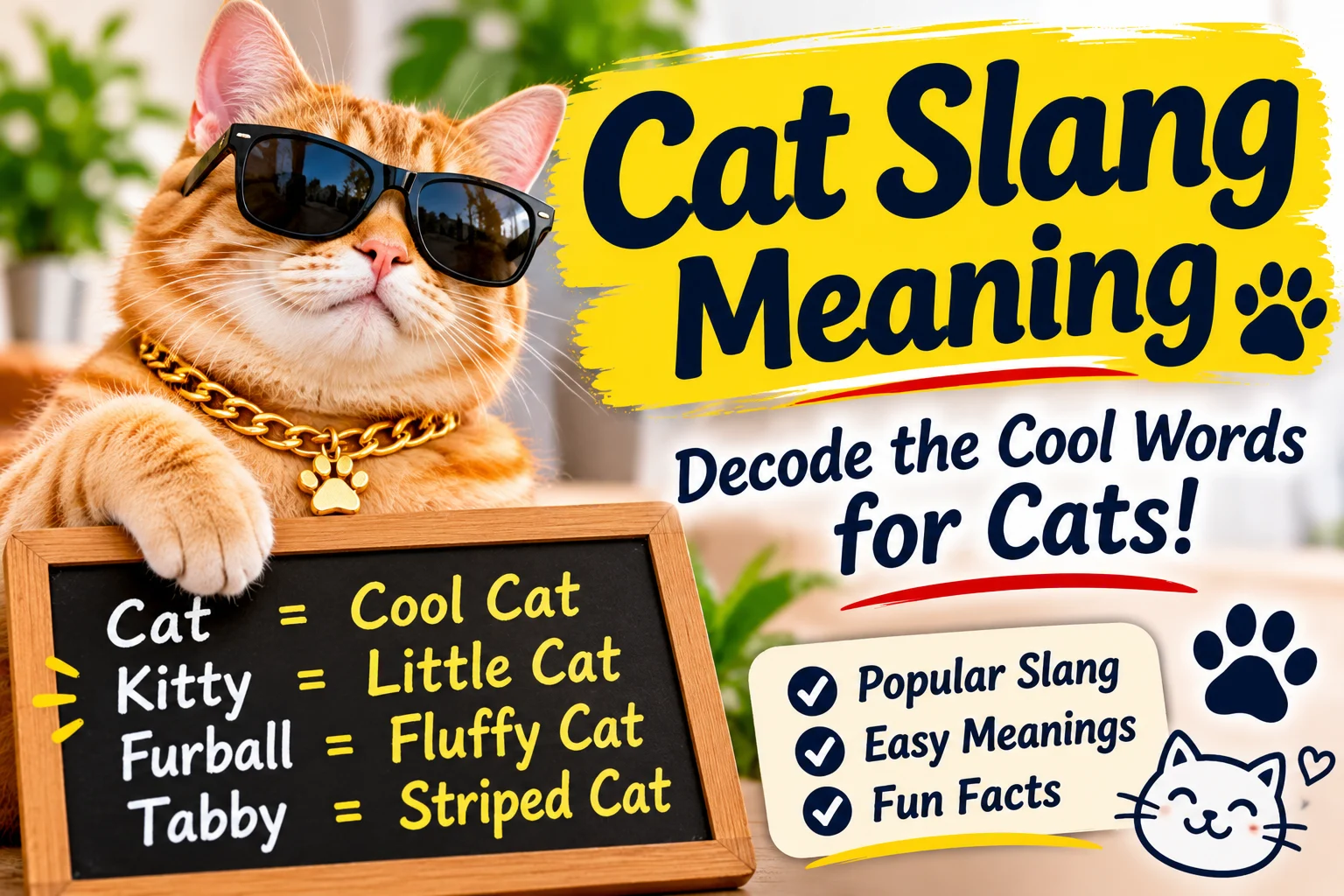
The phrase cat slang meaning can be confusing because the word “cat” has several meanings depending on where and how it is used. In ordinary English, a cat is a domesticated feline, but in slang, cat can refer to a person, especially a man, fellow, or guy. Historically, the word also became associated with jazz culture, where a “cat” could refer to a musician, fan, or someone considered knowledgeable and stylish.
Today, people may encounter “cat” in text messages, WhatsApp conversations, Instagram comments, TikTok captions, memes, dating profiles, and casual conversations. At the same time, the capitalized abbreviation CAT has completely different meanings in medicine, physics, and aviation. For example, a CAT scan refers to computed tomography, while CAT in aviation commonly means clear-air turbulence.
Understanding the surrounding words is therefore the key to interpreting “cat” correctly.
Meaning & Definition
In slang, cat traditionally means a person, fellow, guy, or man. It is an informal usage that became particularly recognizable in American English. The term has also been associated with jazz culture, where a “cat” could refer to a musician or someone familiar with the jazz scene.
For example:
- “That cat knows what he’s doing.”
- “I met this cool cat at the concert.”
- “Some cat left his jacket here.”
In these sentences, “cat” does not refer to an animal. It refers to a person.
The expression “cool cat” gives the word a more positive meaning. It can describe someone who is fashionable, relaxed, confident, interesting, or socially impressive. The phrase has historical connections with American slang and jazz culture.
However, modern readers should not automatically interpret every use of “cat” as a compliment. Depending on the sentence, it may simply mean “guy” or “person,” or it may sound humorous, old-fashioned, playful, or deliberately retro.
Capitalization can also matter. cat in casual writing is usually the ordinary word or slang term, while CAT may be an acronym. For example, CAT can refer to clear-air turbulence in aviation or a CAT scan in medicine.
The safest way to determine the meaning is to consider the entire sentence and the subject being discussed.
Background
The slang history of cat is closely connected with American informal language and jazz culture. The exact origin of this slang usage is not completely settled, so it is useful to distinguish documented historical usage from theories about its origin.
The term became particularly prominent in the 20th century, when “cat” was used to describe a man, fellow, or person. It also developed a specific association with jazz musicians and enthusiasts. This connection helped give expressions such as “cool cat” their distinctive cultural flavor.
Jazz culture played an important role in popularizing the term. Musicians and fans used “cat” as an informal way of referring to people involved in the scene. Over time, the expression moved beyond jazz and entered wider American popular culture.
The phrase “cool cat” eventually became a general expression for someone who appeared relaxed, fashionable, confident, or socially knowledgeable. It could describe a person’s attitude, style, or personality.
The word has subsequently appeared in music, movies, literature, television, advertising, and everyday conversation. Because of its history, using “cat” to mean a person can sometimes give speech a deliberately old-fashioned or retro feeling.
Modern slang has changed considerably, and younger speakers are generally more likely to use words such as guy, dude, bro, man, or person. Nevertheless, “cat” remains recognizable, particularly in phrases such as “cool cat” and in discussions of older American or jazz culture.
Its historical background explains why the word can suggest style or coolness even when the speaker is not consciously referring to its origins.
Usage in Different Contexts: Chat, Social Media, and Professional Fields
The meaning of cat changes significantly according to the communication setting.
In casual conversation, “cat” can simply mean a person:
“I saw this cat at the store.”
Here, the speaker probably means “guy” or “person.” It does not necessarily communicate anything about the individual’s personality.
In music or cultural discussions, however, “cat” may have a more specialized meaning. A jazz musician or someone knowledgeable about jazz may historically be described as a “cat.”
On social media, context becomes especially important. Someone might write:
“That cat is hilarious.”
This probably means “that guy is hilarious.” In another post, however, a literal cat may be the subject:
“My cat learned to open the door.”
Professional environments are different. In medicine, aviation, science, and engineering, CAT is often an abbreviation rather than slang.
For example, a medical professional may use “CAT scan” to refer to computed tomography. In aviation, CAT can mean clear-air turbulence. CAT I, CAT II, and CAT III can also refer to categories of instrument-landing operations.
Therefore, readers should not assume that every occurrence of “cat” has the same meaning. The sentence, platform, capitalization, and subject matter all provide clues.
The safest approach is to interpret the whole expression rather than the word in isolation.
Meaning in Chat, WhatsApp, Instagram, and TikTok
In messaging and social media, cat is usually interpreted according to the tone and context of the conversation.
In WhatsApp or ordinary text messages, “cat” can be an informal substitute for guy, dude, fellow, or person. For example:
“Who’s that cat you were talking to?”
This may simply mean:
“Who’s that guy you were talking to?”
A phrase such as “cool cat” is more clearly positive. It suggests someone who is relaxed, stylish, confident, interesting, or admirable.
On Instagram, “cat” can have several interpretations. A caption such as:
“Met some cool cats tonight.”
probably refers to people.
By contrast:
“Hanging out with my cats.”
could refer literally to pets.
TikTok adds another layer because users frequently revive older expressions for humor, irony, nostalgia, or a particular aesthetic. Someone may use “cool cat” because it sounds retro or playful rather than because it is part of their everyday vocabulary.
The word can also appear inside other expressions:
- Cool cat — a stylish, relaxed, or admirable person.
- Cat person — someone who likes or prefers cats.
- Copycat — someone who imitates another person.
- Fat cat — traditionally, a wealthy or influential person.
- Scaredy-cat — someone who is easily frightened.
These expressions should not be interpreted by looking only at the word “cat.”
Internet communities can also create temporary meanings, jokes, and memes. A TikTok comment may therefore use “cat” in a way that only makes sense within a particular trend.
When interpreting online slang, read the whole sentence and surrounding conversation before deciding what the speaker means.
Meaning in Physics, Medical, and Aircraft Terminology
The capitalized form CAT can refer to technical concepts that have nothing to do with slang.
CAT in Physics and Atmospheric Science
In atmospheric science and aviation, CAT commonly means clear-air turbulence. This describes turbulence occurring without obvious clouds or other visible signs. It is particularly associated with high-altitude flight and areas of strong wind shear.
Clear-air turbulence can be difficult to identify visually because there may be little or no visible cloud activity associated with it.
Therefore, if someone says:
“The aircraft encountered CAT.”
they are probably referring to turbulence rather than a person or animal.
CAT in Medicine
In medicine, CAT scan is a traditional term for a computed tomography scan, commonly called a CT scan.
A CT scan uses X-rays and computer processing to create detailed cross-sectional images of the body. It is used to examine structures such as the brain, chest, abdomen, bones, and blood vessels.
Thus, “CAT scan” has no connection with slang “cat.”
CAT in Aviation
Aviation uses CAT in more than one technical sense.
The abbreviation CAT can mean clear-air turbulence, especially in weather and flight-operation discussions.
You may also encounter CAT I, CAT II, and CAT III in connection with instrument landing systems. These categories describe different levels of precision approach and landing capability, particularly during reduced-visibility conditions.
Consequently, the surrounding aviation terminology is essential for determining which meaning is intended.
Common Misconceptions
One common misconception is that “cat” always means a cool person. That is not necessarily true. The slang term can simply mean a person, guy, or fellow. The “cool” association is especially strong when the expression is “cool cat.”
Another misconception is that CAT always means a slang term online. In medical or aviation discussions, it is much more likely to be a technical abbreviation.
A third misconception is that the person-related meaning of “cat” is modern internet slang. In reality, this usage has a much longer history and became particularly associated with 20th-century American informal language and jazz culture.
It is also incorrect to assume that calling someone “cat” is automatically insulting. Depending on the context, it can be neutral, complimentary, humorous, or old-fashioned.
For example:
“That cat is really talented.”
may be friendly and positive.
But:
“Some strange cat was standing outside.”
may sound dismissive or suspicious.
Another mistake is confusing “cat person” with the slang meaning of “cat.” In most contexts, “cat person” simply means someone who likes cats.
Finally, CAT in technical writing should not automatically be interpreted as slang. A doctor, pilot, meteorologist, or aviation professional is likely using the abbreviation in a specialized sense.
The basic rule is simple: context comes first.
Similar Terms & Alternatives
If “cat” is being used as slang for a person, several alternatives can communicate a similar idea.
Guy
Guy is a straightforward modern alternative when referring to a man or male person. It is widely understood and generally less stylistically marked than “cat.”
Dude
Dude is casual and friendly. It is common in informal conversations and can also be used as a form of address.
Fellow
Fellow is somewhat more traditional than “cat,” but it can also refer to a man or person.
Man
Man is extremely common in casual speech and can refer to a male person or serve as an informal form of address.
Bro
Bro is strongly associated with contemporary informal speech and often suggests familiarity or friendship.
Cool Cat
Cool cat is more specific than “cat.” It generally suggests someone who is relaxed, stylish, confident, or admirable.
Hepcat
Hepcat is a historical expression associated with jazz culture and people considered knowledgeable about jazz or fashionable cultural trends.
The best alternative depends on the desired tone. “Guy” is neutral and modern, “dude” is casual, “bro” is familiar, and “cool cat” is playful and somewhat retro.
For professional communication, clearer terms such as person, individual, colleague, customer, client, employee, or man are generally preferable.
How to Respond to It
How you respond to cat depends on what the speaker means.
If someone says:
“You’re a cool cat.”
A natural response could be:
“Haha, thanks!”
or:
“I’ll take that as a compliment.”
If someone asks:
“Who’s that cat?”
and you know who they mean, simply answer the question:
“That’s Ahmed from my class.”
If you are unsure, you can clarify:
“Do you mean that guy?”
or:
“What do you mean by ‘cat’?”
Clarification is particularly useful online because slang can vary between different communities.
If “cat” appears in a professional conversation, first identify the field. For example, in aviation, “CAT” may refer to clear-air turbulence. In medicine, “CAT scan” refers to computed tomography.
When communicating yourself, choose wording appropriate to the audience. “Cat” can be fun and informal among friends, but “person,” “individual,” or another specific term is usually clearer in professional writing.
Differences from Similar Words
The difference between cat, guy, dude, bro, and cool cat is mainly a matter of tone and cultural association.
| Term | Typical meaning | Tone |
|---|---|---|
| Cat | Person, guy, fellow | Informal, sometimes retro |
| Guy | Man/person | Neutral, everyday |
| Dude | Person/man | Casual, friendly |
| Bro | Male friend/person | Very casual, familiar |
| Cool cat | Stylish, relaxed, admirable person | Positive, playful, retro |
| Hepcat | Jazz-aware or culturally “hip” person | Historical, jazz-related |
“Cat” is distinctive because its person-related meaning can sound older than many modern alternatives.
“Cool cat” is more clearly complimentary, while “guy” generally carries little additional judgment.
Another important distinction is between cat and kitten when referring to people. “Kitten” can appear in affectionate, flirtatious, or sexualized language, so it should not be treated as a direct synonym for slang “cat.”
Similarly, copycat does not simply mean “cat.” It refers to someone who copies or imitates another person.
Technical meanings should also be kept separate from slang. In a medical or aviation context, replacing CAT with “guy” or “person” would obviously be incorrect.
Relevance in Online Conversations & Dating Apps
On dating apps and online conversations, cat can appear as a playful way of referring to a person, particularly when the writer has a humorous, nostalgic, or informal style.
For example:
“Met this cool cat at the coffee shop.”
Here, “cat” probably means a person or guy, while “cool” adds a positive description.
However, dating-app conversations can make interpretation more subjective. A phrase that sounds charming to one person may sound old-fashioned or unusual to another. Someone describing themselves as a “cool cat” may be intentionally presenting a relaxed, confident, artistic, or retro personality.
The term can also appear in conversations about pets:
“I’m definitely a cat person.”
In this case, cat person normally means someone who likes cats rather than someone being described using slang.
On Instagram and TikTok, people may use “cat” ironically or as part of a meme. Social-media language changes quickly, so an isolated comment should not automatically be assigned a fixed meaning.
Dating conversations also depend heavily on tone. If someone calls you “cool cat,” the phrase is generally positive in its traditional sense, but it does not automatically indicate romantic interest. The phrase describes an impression or personality style rather than proving attraction.
When interpreting slang in dating conversations, consider the entire exchange, relationship, and tone instead of assigning a hidden meaning to one word.
Conclusion
The meaning of cat changes considerably depending on context. As slang, it can mean a person, guy, fellow, or—especially in expressions such as cool cat—someone stylish, relaxed, confident, or admired. Its history is strongly connected with American informal language and jazz culture.
In modern chat, WhatsApp, Instagram, TikTok, and dating conversations, the word is generally informal and context-dependent. It can be playful, humorous, nostalgic, or simply another way of saying “guy.”
However, CAT can mean something completely different in technical fields. In medicine, a CAT word is therefore to examine the sentence and subject around it. If the conversation is casual, “cat” may mean a person. If the conversation is medical, scientific, or aviation-related, CAT is more likely to be a scan refers to computed tomography. In atmospheric science and aviation, CAT commonly means clear-air turbulence. CAT I, CAT II, and CAT III can also refer to categories of instrument-landing operations.
The easiest way to understand the word is therefore to examine the sentence and subject around it. If the conversation is casual, “cat” may mean a person. If the conversation is medical, scientific, or aviation-related, CAT is more likely to be a technical abbreviation.
MBN Slang Meaning: What Does MBN Mean in Text, Chat, TikTok, and More?

I am a professional content writer with a passion for English grammar, slang, vocabulary, and everyday language. I specialize in creating clear, engaging, and easy-to-understand articles about grammar rules, slang meanings, phrases, expressions, and modern English usage. My goal is to help readers understand language better, communicate naturally, and use English with confidence.